
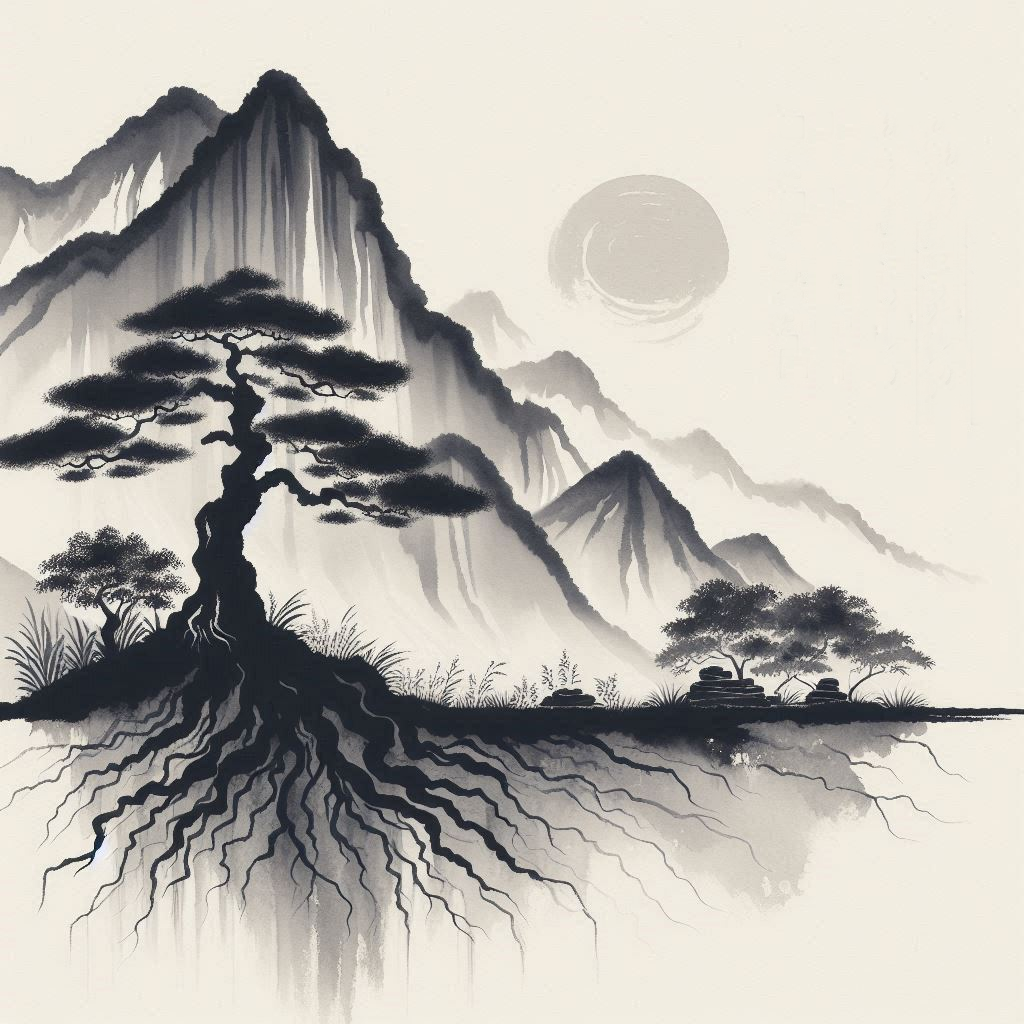
Chapter 59 of Laozi's Tao Te Ching is a chapter that emphasizes that in governing people and conforming to the natural order (Heaven), nothing is more important than 'moderation' or 'frugality' (嗇). It explains how this moderation leads to 'deeply accumulating Virtue' (重積德), and how this accumulated Virtue ultimately becomes the foundation for achieving invincible power, stable governance, and longevity. Using the metaphor of deep roots and a firm base, it speaks of the sustainability of a life and governance that follows the Tao (道).
📖 Table of Contents
- ✨ Introduction
- 📜 Original Text (原文)
- 📃 Meaning of the Original Text
- 🌲 Line-by-Line Translation
- 💧 Verse-by-Verse Commentary and Interpretation
- 治人事天 莫若嗇 (zhì rén shì tiān, mò ruò sè)
- 夫唯嗇 是以早服 (fū wéi sè, shì yǐ zǎo fú)
- 早服謂之重積德 (zǎo fú wèi zhī chóng jī dé)
- 重積德則無不克 (chóng jī dé zé wú bù kè)
- 無不克則莫知其極 (wú bù kè zé mò zhī qí jí)
- 莫知其極 可以有國 (mò zhī qí jí, kě yǐ yǒu guó)
- 有國之母 可以長久 (yǒu guó zhī mǔ, kě yǐ cháng jiǔ)
- 是謂深根固柢 長生久視之道 (shì wèi shēn gēn gù dǐ, cháng shēng jiǔ shì zhī dào)
- 🌳 Overall Interpretation
- 🌟 The Meaning and Importance of Chapter 59
📜 Original Text (原文)
治人事天 莫若嗇
夫唯嗇 是以早服
早服謂之重積德
重積德則無不克
無不克則莫知其極
莫知其極 可以有國
有國之母 可以長久
是謂深根固柢 長生久視之道
📃 Meaning of the Original Text
In governing people and serving Heaven, there is nothing better than moderation.
Indeed, only through moderation can one submit early to the Way.
Submitting early to the Way is called heavily accumulating Virtue.
By heavily accumulating Virtue, there is nothing that cannot be overcome.
When there is nothing that cannot be overcome, no one knows one's limit.
When no one knows one's limit, one is fit to govern a country.
Possessing the Mother of the country, one can long endure.
This is called having deep roots and a firm base. This is the Way (Tao) of long life and lasting vision.
🌲 Line-by-Line Translation
治人事天 莫若嗇 (zhì rén shì tiān, mò ruò sè)
In governing people and serving Heaven, there is nothing better than moderation.
夫唯嗇 是以早服 (fū wéi sè, shì yǐ zǎo fú)
Indeed, only through moderation can one submit early to the Way.
早服謂之重積德 (zǎo fú wèi zhī chóng jī dé)
Submitting early to the Way is called heavily accumulating Virtue.
重積德則無不克 (chóng jī dé zé wú bù kè)
By heavily accumulating Virtue, there is nothing that cannot be overcome.
無不克則莫知其極 (wú bù kè zé mò zhī qí jí)
When there is nothing that cannot be overcome, no one knows one's limit.
莫知其極 可以有國 (mò zhī qí jí, kě yǐ yǒu guó)
When no one knows one's limit, one is fit to govern a country.
有國之母 可以長久 (yǒu guó zhī mǔ, kě yǐ cháng jiǔ)
Possessing the Mother of the country, one can long endure.
是謂深根固柢 長生久視之道 (shì wèi shēn gēn gù dǐ, cháng shēng jiǔ shì zhī dào)
This is called having deep roots and a firm base. This is the Way (Tao) of long life and lasting vision.
💧 Verse-by-Verse Commentary and Interpretation (逐句解說與解釋)
1. 治人事天 莫若嗇 (zhì rén shì tiān, mò ruò sè)
o Literal Meaning: For governing people and serving Heaven, there is nothing like moderation.
o Commentary: '治人' (zhì rén) means to govern people, to rule. '事天' (shì tiān) means to serve Heaven, to conform to the natural order or the principles of the Tao. These represent the two great duties of a leader (king). '莫若' (mò ruò) is a superlative expression meaning 'nothing is better than,' or 'the best is.' '嗇' (sè) has various meanings, including to conserve, to be frugal, to be moderate, to preserve, or even to be stingy. Here, it signifies an attitude of avoiding artificial waste or excessive consumption, conserving energy and resources, and restraining artificial desires and activities.
o Interpretation: This declares that in governing people and living in harmony with the natural order, the most important and best method is 'moderation' (嗇)—conserving and restraining one's energy, resources, mind, and activities, rather than exerting artificial effort or pursuing desires.
2. 夫唯嗇 是以早服 (fū wéi sè, shì yǐ zǎo fú)
o Literal Meaning: Indeed, only through moderation can one submit early.
o Commentary: '夫唯嗇' (fū wéi sè) means 'Indeed, only moderation,' emphasizing the preceding point. '是以' (shì yǐ) means 'by this means' or 'for this reason.' '早服' (zǎo fú) means 'to submit/conform (服) early (早).' What one submits to depends on the context. It can mean submitting early to one's own nature, the principles of the Tao, the flow of nature, or the needs of the people.
o Interpretation: Only by practicing moderation and avoiding artificial waste and excessive consumption can one naturally follow one's own nature or conform to the principles of the Tao. It suggests that true submission (服) becomes possible when artificial desires are reduced.
3. 早服謂之重積德 (zǎo fú wèi zhī chóng jī dé)
o Literal Meaning: Submitting early is called heavily accumulating Virtue.
o Commentary: '早服' (zǎo fú) refers to the state/ability of 'submitting early' mentioned before. '謂之' (wèi zhī) means 'is called.' '重積德' (chóng jī dé) means 'to heavily (重) accumulate (積) Virtue (德).' This suggests that conforming to the Tao and one's nature is the very act of building up a deep and substantial reserve of inner Virtue (De).
o Interpretation: The natural ability to conform early, gained through moderation, is not a passive act but an active process of building up one's inner Virtue. Every act of conforming to the Way adds to one's store of De, making it deep and substantial.
4. 重積德則無不克 (chóng jī dé zé wú bù kè)
o Literal Meaning: By heavily accumulating Virtue, there is nothing that cannot be overcome.
o Commentary: '重積德' (chóng jī dé) refers to having a deep store of Virtue. '則無不克' (zé wú bù kè) is a double negative construction meaning 'then (則) there is nothing (無) that is not (不) overcome (克),' which translates to 'can overcome anything' or 'there is nothing unconquerable.'
o Interpretation: When one's inner Virtue is deep and firmly accumulated, one gains an invincible (無敵) strength that can overcome any external difficulty or opposition. This is not physical strength or violence, but a true strength derived from inner stability, harmony, and union with the Tao (similar to Chapter 22, 'Because they do not contend, no one in the world can contend with them').
5. 無不克則莫知其極 (wú bù kè zé mò zhī qí jí)
o Literal Meaning: When there is nothing that cannot be overcome, no one knows one's limit.
o Commentary: '無不克' (wú bù kè) is the state of being able to overcome anything. '莫知其極' (mò zhī qí jí) means 'no one (莫) knows (知) its (其) limit/end (極)'.
o Interpretation: When one possesses an inner strength that can overcome anything, no one can know the limit of that ability. Because this strength is not displayed externally but is deeply internalized, its depth and extent cannot be fathomed, and thus no one dares to challenge it.
6. 莫知其極 可以有國 (mò zhī qí jí, kě yǐ yǒu guó)
o Literal Meaning: When no one knows one's limit, one is fit to govern a country.
o Commentary: '莫知其極' (mò zhī qí jí) is the state where the limit of one's ability is unknown. '可以有國' (kě yǐ yǒu guó) means 'one can (可以) possess/govern (有) a country (國).' This discusses the qualification for kingship, connecting to Chapter 25.
o Interpretation: When one's inner strength is so deep and unfathomable that its limits are unknown, no one will dare to challenge them rashly, thus qualifying them to govern a country stably. This shows that stable rule can be achieved through deep inner Virtue rather than by governing with artificial force.
7. 有國之母 可以長久 (yǒu guó zhī mǔ, kě yǐ cháng jiǔ)
o Literal Meaning: Possessing the Mother of the country, one can long endure.
o Commentary: '有國之母' (yǒu guó zhī mǔ) means 'the Mother (母) of possessing/governing a country (有國)'. Here, 'Mother' is a metaphor for the Tao, the source of all things, or the fundamental principle derived from the Tao (heavily accumulated Virtue) (see Chapters 1, 25, 52). '可以長久' (kě yǐ cháng jiǔ) means 'one can (可以) long endure/be everlasting (長久)'.
o Interpretation: The fundamental principle of governing a country stably by deeply accumulating Virtue (重積德) is the very foundation, like a Mother, that makes the country's existence possible and allows it to endure for a long time. It emphasizes that only governance based on the principles of the Tao can be everlasting.
8. 是謂深根固柢 長生久視之道 (shì wèi shēn gēn gù dǐ, cháng shēng jiǔ shì zhī dào)
o Literal Meaning: This is called having deep roots and a firm base. This is the Way (Tao) of long life and lasting vision.
o Commentary: '是謂' (shì wèi) refers to the entire process described before (Moderation -> Early Submission -> Accumulating Virtue -> Invincibility -> Limitless Power -> Fitness to Rule -> Longevity). In '深根固柢' (shēn gēn gù dǐ), '深根' (shēn gēn) means deep roots, and '固柢' (gù dǐ) means a firm base/foundation. This is a metaphor for a stable foundation, just as a tree with deep roots and a solid trunk does not sway. '長生久視之道' (cháng shēng jiǔ shì zhī dào) is 'the Way (道) of long life (長生) and lasting vision/endurance (久視)'. '久視' (jiǔ shì), beyond simply seeing for a long time, can signify enduring for a long time and observing the world, implying eternity (connects to Chapter 7, 'Heaven is long-lasting and Earth is enduring').
o Interpretation: Deeply accumulating Virtue through moderation and restraint, and the invincible power and stable governance gained thereby, is like a tree setting down deep roots and establishing a firm base. This is the very method of the 'Tao' that preserves one's life for a long time, allows one's influence or legacy to endure, and penetrates the unchanging truth for ages.
🌳 Overall Interpretation
The fifty-ninth chapter tells us how we can protect ourselves and our country safely and for a long time.
In governing people and living in harmony with Heaven (the natural order), it is best to avoid artificial waste and excessive consumption and to practice 'moderation and frugality.'
Indeed, only by practicing such moderation can one begin to 'naturally conform' to one's own nature and the principles of the Tao. This ability to abandon the artificial and submit early to one's nature and the Tao is akin to 'building up a deep and solid store of inner Virtue (德).'
When one's inner Virtue is deeply accumulated, 'there is nothing that cannot be overcome,' no matter the difficulty or opposition. When one possesses this inner strength to overcome all things, 'no one can know' the limit of that ability.
When one's inner strength is so deep that its limit is unknown, no one dares to challenge them rashly, thus giving them the 'qualification to govern a country stably.' This fundamental principle of governing stably by deeply accumulating Virtue is the very 'foundation, like a Mother, that makes the country's existence possible and allows it to 'endure for a long time.'
This process of moderation, self-restraint, accumulating Virtue, and stable governance is like a tree 'setting down deep roots and establishing a firm base.' This is the very 'method of the Tao' that 'preserves one's life for a long time,' allows one's influence or legacy to 'endure,' and 'penetrates the unchanging truth for ages.'
🌟 The Meaning and Importance of Chapter 59
Chapter 59 presents the following core ideas:
- The Importance of Moderation (嗇): It presents moderation as the foundation for governing people and serving Heaven, emphasizing that avoiding artificial waste and excessive consumption is the beginning of a Taoist life.
- Accumulating Virtue Heavily (重積德): It explains that moderation (嗇) and submission (早服) lead to the process of building up inner Virtue (德) deeply and solidly. It implies the importance of the depth of one's Virtue.
- Invincibility (無不克) and Unknowable Limits (莫知其極): It paradoxically states that deeply accumulated Virtue provides an invincible strength to overcome any difficulty, and because the limit of this power is unknown, it wards off external challenges. This is true strength that comes from inner Virtue, not physical might.
- Stable Governance and Perpetuity: It proposes that a person with deeply accumulated Virtue can govern a country stably, and only a governing principle based on this Virtue ('the Mother of the country') can endure for a long time.
- The Metaphor of Deep Roots and a Firm Base (深根固柢): Using this metaphor, it emphasizes that moderation and the accumulation of Virtue are the fundamental methods of the Tao that enable 'long life and lasting vision' (長生久視) for both an individual's life and the stability of a nation.
Chapter 59 is an important chapter that profoundly explains how the core Taoist virtues of 'moderation' and 'self-restraint' are the fundamental principles leading from an individual's inner cultivation to social stability and, ultimately, to eternity. It contains the deep wisdom that building up one's inner substance, rather than pursuing artificial expansion and consumption, brings true strength and sustainability.


댓글