
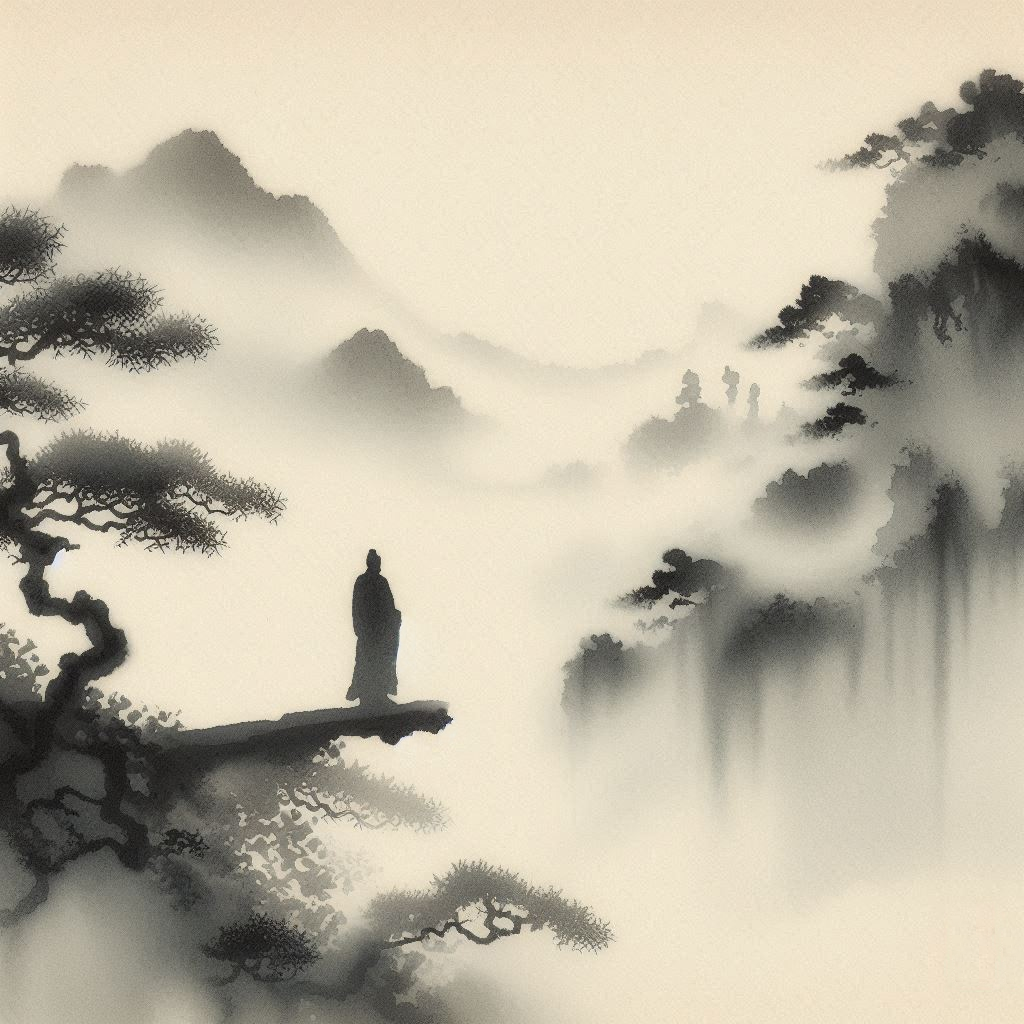
Chapter 20 of Laozi's Tao Te Ching is a chapter that contrastively shows the lonely and simple appearance of one who follows the Tao (道), having moved away from worldly knowledge, values, and a bustling way of life. It expresses the heart of a Taoist who, in contrast to the busyness of the world's people, seeks to obtain the foundation of life from the fundamental 'Mother' of the Tao, abandoning the artificial.
📖 Table of Contents
- ✨ Introduction
- 📜 Original Text (原文)
- 📃 Meaning of the Original Text
- 🌲 Line-by-Line Translation
- 💧 Verse-by-Verse Commentary and Interpretation
- 絕學無憂 (jué xué wú yōu)
- 唯之與阿 相去幾何 (wéi zhī yǔ ē, xiāng qù jǐ hé)
- 善之與惡 相去若何 (shàn zhī yǔ è, xiāng qù ruò hé)
- 人之所畏 不可不畏 (rén zhī suǒ wèi, bù kě bù wèi)
- 荒兮 其未央哉 (huāng xī, qí wèi yāng zāi)
- 衆人熙熙 如享太牢 如春登臺 (zhòng rén xī xī, rú xiǎng tài láo, rú chūn dēng tái)
- 我獨泊兮 其未兆 (wǒ dú bó xī, qí wèi zhào)
- 如嬰兒之未孩 (rú yīng ér zhī wèi hái)
- 纍纍兮 若無所歸 (lěi lěi xī, ruò wú suǒ guī)
- 衆人皆有餘 而我獨若遺 (zhòng rén jiē yǒu yú, ér wǒ dú ruò yí)
- 我愚人之心也哉 沌沌兮 (wǒ yú rén zhī xīn yě zāi, dùn dùn xī)
- 衆人昭昭 我獨昏昏 (zhòng rén zhāo zhāo, wǒ dú hūn hūn)
- 衆人察察 我獨悶悶 (zhòng rén chá chá, wǒ dú mèn mèn)
- 澹兮其若海 飂兮若無止 (dàn xī qí ruò hǎi, liù xī ruò wú zhǐ)
- 衆人皆有以 而我獨頑似鄙 (zhòng rén jiē yǒu yǐ, ér wǒ dú wán sì bǐ)
- 我欲異於人 而貴食母 (wǒ yù yì yú rén, ér guì shí mǔ)
- 🌳 Overall Interpretation
- 🌟 The Meaning and Importance of Chapter 20
📜 Original Text (原文)
絕學無憂
唯之與阿 相去幾何
善之與惡 相去若何
人之所畏 不可不畏
荒兮 其未央哉
衆人熙熙 如享太牢 如春登臺
我獨泊兮 其未兆
如嬰兒之未孩
纍纍兮 若無所歸
衆人皆有餘
而我獨若遺
我愚人之心也哉 沌沌兮
衆人昭昭
我獨昏昏
衆人察察
我獨悶悶
澹兮其若海
飂兮若無止
衆人皆有以
而我獨頑似鄙
我欲異於人 而貴食母
📃 Meaning of the Original Text
Abandon learning, and there will be no sorrow.
Between 'yes' and 'yeah,' what is the distance?
Between 'good' and 'evil,' what is the difference?
What others fear, one cannot but fear.
So vast and desolate, it has no end.
The crowd is joyous and merry, as if enjoying a great feast, as if climbing a terrace in spring.
I alone am tranquil and still, showing no sign or trace.
Like a newborn infant who has not yet learned to smile.
Weary and tired, as if having no place to return.
The crowd all has more than enough.
But I alone seem to have lost something.
Mine is the heart of a fool, so muddled and混沌.
The crowd is bright and clear, I alone am dark and dim.
The crowd is sharp and discerning, I alone am dull and withdrawn.
(My heart is) calm, like the sea.
(Its movement is) like the wind, seemingly without end.
The crowd all has a clear purpose.
But I alone am stubborn and rustic, as if lowly.
I desire to be different from others, and value receiving nourishment from the Mother.
🌲 Line-by-Line Translation
絕學無憂 (jué xué wú yōu)
Abandon learning, and there will be no sorrow.
唯之與阿 相去幾何 (wéi zhī yǔ ē, xiāng qù jǐ hé)
Between 'yes' and 'yeah,' what is the distance?
善之與惡 相去若何 (shàn zhī yǔ è, xiāng qù ruò hé)
Between 'good' and 'evil,' what is the difference?
人之所畏 不可不畏 (rén zhī suǒ wèi, bù kě bù wèi)
What others fear, one cannot but fear.
荒兮 其未央哉 (huāng xī, qí wèi yāng zāi)
So vast and desolate, it has no end.
衆人熙熙 如享太牢 如春登臺 (zhòng rén xī xī, rú xiǎng tài láo, rú chūn dēng tái)
The crowd is joyous and merry, as if enjoying a great feast, as if climbing a terrace in spring.
我獨泊兮 其未兆 (wǒ dú bó xī, qí wèi zhào)
I alone am tranquil and still, showing no sign or trace.
如嬰兒之未孩 (rú yīng ér zhī wèi hái)
Like a newborn infant who has not yet learned to smile.
纍纍兮 若無所歸 (lěi lěi xī, ruò wú suǒ guī)
Weary and tired, as if having no place to return.
衆人皆有餘 而我獨若遺 (zhòng rén jiē yǒu yú, ér wǒ dú ruò yí)
The crowd all has more than enough. But I alone seem to have lost something.
我愚人之心也哉 沌沌兮 (wǒ yú rén zhī xīn yě zāi, dùn dùn xī)
Mine is the heart of a fool, so muddled and混沌.
衆人昭昭 我獨昏昏 (zhòng rén zhāo zhāo, wǒ dú hūn hūn)
The crowd is bright and clear, I alone am dark and dim.
衆人察察 我獨悶悶 (zhòng rén chá chá, wǒ dú mèn mèn)
The crowd is sharp and discerning, I alone am dull and withdrawn.
澹兮其若海 飂兮若無止 (dàn xī qí ruò hǎi, liù xī ruò wú zhǐ)
(My heart is) calm, like the sea. (Its movement is) like the wind, seemingly without end.
衆人皆有以 而我獨頑似鄙 (zhòng rén jiē yǒu yǐ, ér wǒ dú wán sì bǐ)
The crowd all has a clear purpose. But I alone am stubborn and rustic, as if lowly.
我欲異於人 而貴食母 (wǒ yù yì yú rén, ér guì shí mǔ)
I desire to be different from others, and value receiving nourishment from the Mother.
💧 Verse-by-Verse Commentary and Interpretation (逐句解說與解釋)
1. 絕學無憂 (jué xué wú yōu)
o Literal Meaning: Abandon learning, and there will be no sorrow.
o Commentary: '絕學' (jué xué) means to abandon worldly knowledge, scholarship, and artificial teachings. Beyond simply stopping the acquisition of knowledge, it means escaping from the complex ways of thinking and value systems created by knowledge and discrimination. '無憂' (wú yōu) means to be without sorrow or anxiety.
o Interpretation: This is a declaration that when one stops being bound by artificial knowledge, values, and complex ways of thinking, one can escape from the anxieties and worries they create and attain peace of mind. It suggests that worldly knowledge is often the cause of suffering.
2. 唯之與阿 相去幾何 (wéi zhī yǔ ē, xiāng qù jǐ hé)
o Literal Meaning: Between 'yes' and 'yeah,' what is the distance?
o Commentary: '唯' (wéi) and '阿' (ē) are words used in response. '唯' is a positive, affirmative response like "yes, certainly," while '阿' can be a more indifferent or even negative response like "uh-huh" or "oh." It can also be a metaphor for two subtly different attitudes. '相去幾何' (xiāng qù jǐ hé) is a question: "How far apart are they?" or "What is the real difference?"
o Interpretation: This question asks what fundamental difference there really is between an affirmative response and an indifferent or negative one, or between two subtly different reactions. It suggests the superficiality and meaninglessness of artificial social responses and distinctions, showing that from the perspective of the Tao, they are insignificant.
3. 善之與惡 相去若何 (shàn zhī yǔ è, xiāng qù ruò hé)
o Literal Meaning: Between 'good' and 'evil,' what is the difference?
o Commentary: '善之與惡' (shàn zhī yǔ è) refers to 'good' and 'evil.' '相去若何' (xiāng qù ruò hé) is another question: "How different are they?" As stated in Chapter 2, good and evil are artificial and relative concepts.
o Interpretation: This question asks what fundamental difference there truly is between what society considers 'good' and 'evil.' It suggests that human-made moral standards are not absolute, and the distinction between good and evil is relative and superficial. From the Tao's perspective, the opposition of good and evil is meaningless. Together with the previous question, it shows a Taoist critique of artificial distinctions and judgments.
4. 人之所畏 不可不畏 (rén zhī suǒ wèi, bù kě bù wèi)
o Literal Meaning: What others fear, one cannot but fear.
o Commentary: '人之所畏' (rén zhī suǒ wèi) means 'that which people fear,' referring to things the general populace fears (e.g., public opinion, power, death, loss of wealth). '不可不畏' (bù kě bù wèi) is a double negative meaning 'one cannot not fear' or 'one must fear.' The interpretation of this line is debated.
o Interpretation:
- Interpretation 1 (Acknowledging worldly reality): It can be seen as an admission that one cannot be completely free from the worldly values and norms that people fear. A Taoist may still have to be mindful of social constraints.
- Interpretation 2 (What should be truly feared): It could refer to what people *should* truly fear, such as the principles of the Tao or the laws of nature, which humans cannot defy.
- Most fitting interpretation: Given that the previous lines question the emptiness of worldly distinctions, this line likely describes the state of the world: people are so entangled in these artificial standards that they *cannot help but fear* what society tells them to fear (reputation, profit, blame, etc.). It's a commentary on the condition of the crowd, setting the stage for the contrast that follows.
5. 荒兮 其未央哉 (huāng xī, qí wèi yāng zāi)
o Literal Meaning: So vast and desolate, it has no end.
o Commentary: '荒兮' (huāng xī) means vast, desolate, empty, or endless. '其未央哉' (qí wèi yāng zāi), '其' (qí) can refer to the preceding content—the state where people are entangled in artificial distinctions and superficial fears. '未央' (wèi yāng) means 'not yet ended,' 'endless,' or 'eternal.' '哉' (zāi) is a particle expressing exclamation or a question.
o Interpretation: This can be a lament or observation that the state of the world described—entangled in artificial standards and fears—is a vast desolation that continues endlessly. It is a contemplation on the endless repetition of worldly folly.
6. 衆人熙熙 如享太牢 如春登臺 (zhòng rén xī xī, rú xiǎng tài láo, rú chūn dēng tái)
o Literal Meaning: The crowd is joyous and merry, as if enjoying a great feast, as if climbing a terrace in spring.
o Commentary: '衆人' (zhòng rén) means the crowd or the general public. '熙熙' (xī xī) describes a state of being joyous, lively, and bustling. '如享太牢' (rú xiǎng tài láo) means 'like enjoying a great sacrificial feast,' symbolizing abundance and celebration. '如春登臺' (rú chūn dēng tái) means 'like climbing a terrace in spring,' symbolizing a bright, cheerful atmosphere of leisure.
o Interpretation: The people of the world outwardly live joyous and bustling lives, like they are at a festival or on a spring outing. This describes the pursuit of worldly happiness through material abundance or social prestige. It serves as a backdrop to contrast with the author's own state.
7. 我獨泊兮 其未兆 (wǒ dú bó xī, qí wèi zhào)
o Literal Meaning: I alone am tranquil and still, showing no sign or trace.
o Commentary: '我獨' (wǒ dú) means 'I alone,' beginning the contrast. '泊兮' (bó xī) means tranquil, calm, simple, unattached, or still like a boat moored at the shore. '其未兆' (qí wèi zhào), where '其' (qí) can refer to any movement, emotion, desire, or future omen. '未兆' (wèi zhào) means 'not yet shown' or 'not yet sprouted.'
o Interpretation: Unlike the crowd busily chasing pleasure, I (the Taoist) am alone, tranquil, and calm. My mind is in a peaceful state where no emotions, desires, or future plans have yet sprouted. This describes a state of abiding in the Tao without artificial activity or desire.
8. 如嬰兒之未孩 (rú yīng ér zhī wèi hái)
o Literal Meaning: Like a newborn infant who has not yet learned to smile.
o Commentary: '如嬰兒之未孩' (rú yīng ér zhī wèi hái), '如' (rú) means 'like.' '嬰兒' (yīng ér) is a newborn infant. '未孩' (wèi hái) can be interpreted as 'not yet child-like,' 'not yet smiling,' 'not yet knowing the ways of the world,' or 'not yet fully revealing its nature.' The infant is a recurring metaphor for purity, naturalness, and lack of desire.
o Interpretation: This is a metaphor for my state being like that of a newborn infant, untouched by the world, with no artificial emotions or expressions (like smiling) yet appearing. It represents a simple state free from worldly discrimination or desire.
9. 纍纍兮 若無所歸 (lěi lěi xī, ruò wú suǒ guī)
o Literal Meaning: Weary and tired, as if having no place to return.
o Commentary: '纍纍兮' (lěi lěi xī) has various interpretations, including 'weary and tired,' 'entangled,' or 'hanging loosely.' In context, it could describe a state of being weak and not yet rooted in the world, or appearing aimless because one is unattached to worldly things. '若無所歸' (ruò wú suǒ guī) means 'as if (若) there is no (無) place to return (所歸).'
o Interpretation: This calmly describes how someone walking the path of the Tao, detached from worldly life, might appear outwardly as if they are unsettled, weary, or have no place to belong. It is a depiction of the Taoist's lonely and drifting appearance when judged by worldly standards.
10. 衆人皆有餘 而我獨若遺 (zhòng rén jiē yǒu yú, ér wǒ dú ruò yí)
o Literal Meaning: The crowd all has more than enough. But I alone seem to have lost something.
o Commentary: '衆人皆有餘' (zhòng rén jiē yǒu yú) means 'the crowd all has a surplus (有餘),' referring to a state of being materially or socially affluent and at ease. '而我獨若遺' (ér wǒ dú ruò yí), where '而' (ér) is a conjunction 'but.' '我獨' (wǒ dú) is 'I alone.' '若遺' (ruò yí) means 'as if having lost something,' 'as if lacking,' or 'as if abandoned by the world.'
o Interpretation: In contrast to the crowd, who seem to enjoy an abundance of worldly values like wealth, fame, and status, the Taoist, having abandoned such things, appears outwardly as if lacking, deficient, and abandoned by the world. It contrasts worldly abundance with the Taoist's simplicity and apparent lack.
11. 我愚人之心也哉 沌沌兮 (wǒ yú rén zhī xīn yě zāi, dùn dùn xī)
o Literal Meaning: Mine is the heart of a fool, so muddled and混沌.
o Commentary: '我愚人之心也哉' (wǒ yú rén zhī xīn yě zāi), '我' (wǒ) is I. '愚人' (yú rén) is a foolish person. '之心' (zhī xīn) is 'the heart of.' '也哉' (yě zāi) is a particle expressing exclamation or self-deprecation. '沌沌兮' (dùn dùn xī), '沌沌' (dùn dùn) signifies the chaotic state before form, a state of being mixed and unclear. It's similar to the concept in Chapter 1.
o Interpretation: From the world's perspective, my state of mind seems foolish and lacking in discrimination, as if it is in the undifferentiated state of primordial chaos. This self-description shows the Taoist ideal of abandoning artificial knowledge and discrimination to approach the fundamental chaotic state of the Tao. Worldly 'wisdom' is contrasted with a positively embraced 'foolishness.'
12. 衆人昭昭 我獨昏昏 (zhòng rén zhāo zhāo, wǒ dú hūn hūn)
o Literal Meaning: The crowd is bright and clear, I alone am dark and dim.
o Commentary: In '衆人昭昭' (zhòng rén zhāo zhāo), '昭昭' (zhāo zhāo) means bright and clear, a state of clearly discriminating between things. In '我獨昏昏' (wǒ dú hūn hūn), '昏昏' (hūn hūn) means dark and dim, a state of not clearly discriminating. This contrast between clarity and obscurity is used to describe the state of the Tao or the attitude of a Taoist.
o Interpretation: While the people of the world use artificial knowledge and discrimination to clearly distinguish and judge things, the Taoist, having abandoned such artificial knowing, appears as if they see things obscurely, without sharp distinctions. It contrasts worldly clarity with the Taoist's lack of discrimination.
13. 衆人察察 我獨悶悶 (zhòng rén chá chá, wǒ dú mèn mèn)
o Literal Meaning: The crowd is sharp and discerning, I alone am dull and withdrawn.
o Commentary: In '衆人察察' (zhòng rén chá chá), '察察' (chá chá) means to scrutinize things meticulously and in detail. In '我獨悶悶' (wǒ dú mèn mèn), '悶悶' (mèn mèn) means dull, withdrawn, and unconcerned, calmly facing complex issues without deep worry.
o Interpretation: While the people of the world meticulously calculate their gains and losses and scrutinize every little thing, the Taoist faces things calmly and without calculation. It contrasts the worldly calculative attitude with the Taoist's non-attachment, deepening the previous contrast.
14. 澹兮其若海 飂兮若無止 (dàn xī qí ruò hǎi, liù xī ruò wú zhǐ)
o Literal Meaning: (My heart is) calm, like the sea. (Its movement is) like the wind, seemingly without end.
o Commentary: In '澹兮' (dàn xī), '澹' (dàn) means calm, clear, quiet, or peaceful. '其若海' (qí ruò hǎi) means 'it is like the sea.' Here, 'it' refers to my state of mind or the Tao. In '飂兮' (liù xī), '飂' (liù) depicts the sound or shape of the wind blowing, or something moving lightly. '若無止' (ruò wú zhǐ) means 'as if there is no stopping.'
o Interpretation: This is a metaphor for my state of mind (or the Tao's nature) being as deep, vast, calm, and tranquil as the sea, while also being as free and unrestrained as the wind that flows without stopping. It expresses that although I may appear foolish and obscure on the outside, my inner state is in a realm as vast and free as the Tao itself.
15. 衆人皆有以 而我獨頑似鄙 (zhòng rén jiē yǒu yǐ, ér wǒ dú wán sì bǐ)
o Literal Meaning: The crowd all has a clear purpose. But I alone am stubborn and rustic, as if lowly.
o Commentary: In '衆人皆有以' (zhòng rén jiē yǒu yǐ), '有以' (yǒu yǐ) means 'to have a purpose,' 'to have a reason,' or 'to have a use or value.' In '而我獨頑似鄙' (ér wǒ dú wán sì bǐ), '頑' (wán) means foolish, stubborn, or simple. '似鄙' (sì bǐ) means 'seems as if lowly/rustic' (鄙).
o Interpretation: While everyone in the world lives busily with their own life's purpose, pursued values, or personal use, I, detached from such worldly purposes and values, may appear stubborn and foolish, and in the eyes of the world, insignificant or lowly.
16. 我欲異於人 而貴食母 (wǒ yù yì yú rén, ér guì shí mǔ)
o Literal Meaning: I desire to be different from others, and value receiving nourishment from the Mother.
o Commentary: '我欲異於人' (wǒ yù yì yú rén) means 'I (我) desire to be different from (欲異於) others (人).' This shows that the contrast with the crowd is an intentional, voluntary choice. In '而貴食母' (ér guì shí mǔ), '貴' (guì) means to value or cherish. '食母' (shí mǔ) means 'to eat from the Mother (母).' Here, 'Mother' (母) is a metaphor for the Tao, the source of all things. '食母' means to receive life force, wisdom, and nourishment from the Tao—to live in accordance with the Tao.
o Interpretation: This concludes that I intentionally choose to live differently from the crowd. Instead of worldly, superficial values and knowledge, I cherish most dearly the act of receiving life force and truth directly from the Tao (the Mother)—that is, living according to the Tao. This is the fundamental reason and goal for the Taoist to turn away from the world and choose the path of the Tao.
🌳 Overall Interpretation
The twentieth chapter contrasts the life of the world's people with my own life following the Tao, explaining my path.
If you stop being entangled in worldly knowledge or artificial teachings, you can find peace and be free from the anxieties they create. Think about it, what is the fundamental difference between an affirmative 'yes' and an indifferent 'yeah'? Also, what fundamental difference is there between what people consider 'good' and 'evil'? In the end, the state of the world, where people are bound by worldly standards and foolishly cannot help but fear them, is like a vast and endless desolation.
The crowd pursues fame and fortune, living joyously and boisterously, as if enjoying a grand festival or a spring outing. But I alone am tranquil and still, as if no emotions, desires, or future plans have yet sprouted in my heart. I appear like a newborn infant, pure and untouched by the world. Outwardly, it may seem as if I am unsettled, weary, or have no place to belong in the world. While the crowd seems to have an abundance of possessions (wealth, status, etc.), I alone appear as if I have nothing, lacking and abandoned by the world.
In the eyes of the world, I seem to have the 'heart of a fool,' and my thoughts and discriminations appear 'muddled and unclear.' While the crowd is 'bright and clear,' clearly distinguishing and judging things, I alone, having abandoned such artificial knowledge, seem 'dark and dim.' While the crowd is 'sharp and discerning,' meticulously calculating gains and losses, I alone, without such calculation, seem 'dull and withdrawn.'
But my inner self is different. My heart is as deep, vast, calm, and tranquil as the sea, and yet it is as free and unrestrained as the wind that flows without stopping.
While the crowd lives busily with their own life's purpose, pursued values, or personal use, I, detached from such worldly things, may appear stubborn and foolish, and in the eyes of the world, insignificant or lowly.
But I intentionally choose to live differently from the crowd. Instead of superficial worldly values, I cherish most dearly the act of receiving life force and truth directly from the Tao (the Mother)—that is, living according to the Tao.
🌟 The Meaning and Importance of Chapter 20
Chapter 20 presents the following core ideas:
- Critique of Worldly Values: It criticizes artificial knowledge, social distinctions (like good and evil), the superficial pursuit of happiness, and a purpose-driven life as being empty, foolish, and the cause of anxiety and chaos from the Tao's perspective.
- The Alienation and Solitude of the Taoist: It calmly describes how the path of following the Tao, by departing from worldly values and norms, can appear alienated from the crowd, foolish, lacking, and lonely. This acknowledges that the path of the Tao is not a popular one.
- The Positive Meaning of 'Foolishness': It positively embraces the state of appearing foolish and obscure ('愚人', '沌沌', '昏昏', '悶悶') after abandoning worldly 'wisdom' and 'discrimination.' This signifies a pure and fundamental state before artificial distinctions, a state close to the Tao.
- Inner Vastness and Freedom: In contrast to the outward appearance of alienation, it uses metaphors to express the Taoist's inner state as a realm as tranquil and deep as the sea, and as free and infinite as the wind.
- The Principle of 'Valuing Feeding from the Mother' (貴食母): The ultimate reason for following the Tao is the cherishing of living not on worldly sustenance, but on receiving life force and truth directly from the Tao (the Mother). This is the fundamental motivation and goal of the Taoist life.
Chapter 20 is considered one of the chapters that best reveals Laozi's personal sentiments. Along with a sharp critique of worldly values, it candidly shows the lonely and solitary, yet internally rich and free, life of one who follows the Tao. It is an important chapter that expresses a strong will to walk the path of the Tao without compromising with the world.


댓글