
Chapter 24 of Laozi's Tao Te Ching uses analogies to explain how artificial and forced efforts, as well as actions of self-display and showing off, lead to futile and harmful consequences. From the perspective of the Tao (道), these artificial actions are nothing more than unnecessary and harmful 'excesses.' The chapter emphasizes that those who follow the Tao must avoid such ways.
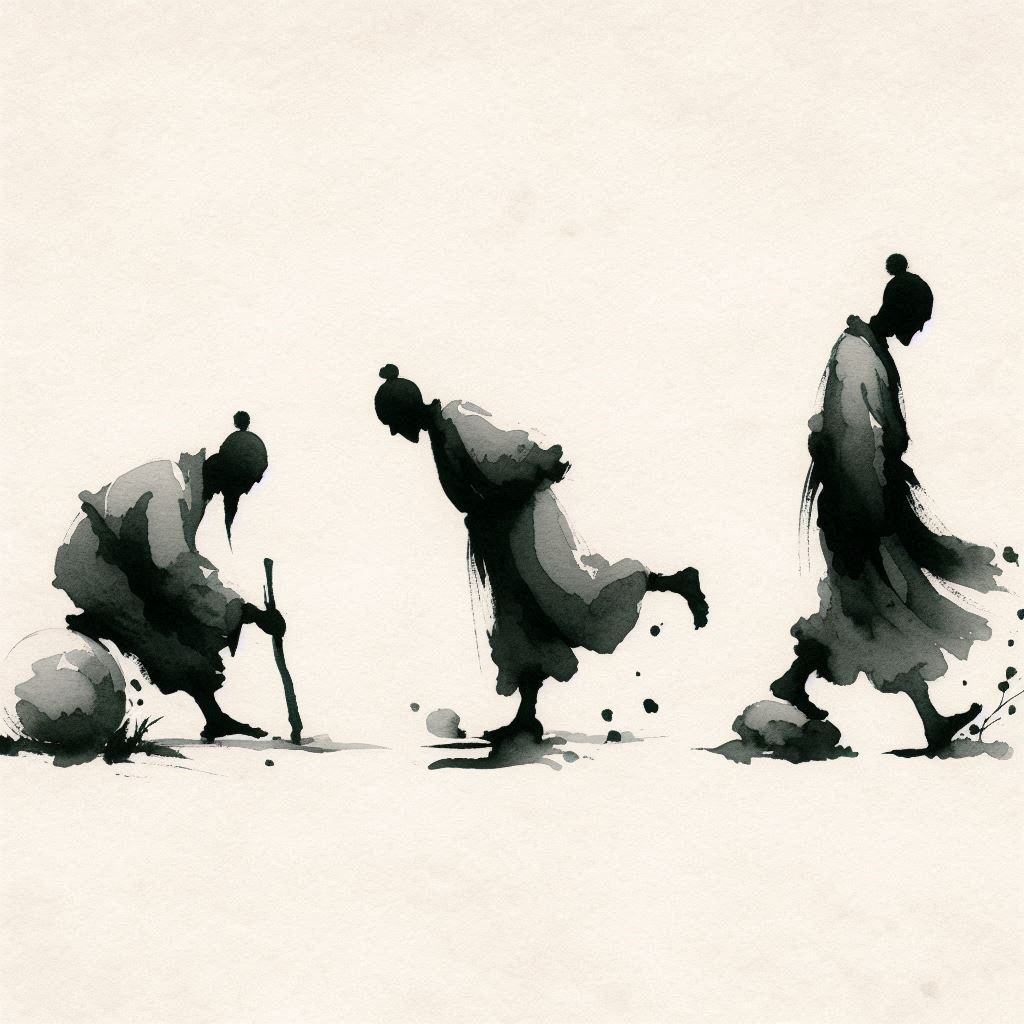
📜 Original Text (原文)
企者不立
跨者不行
自見者不明
自是者不彰
自伐者無功
自矜者不長
其於道也 曰餘食贅形
物或惡之
故有道者不處
📃 Meaning of the Original Text
One who stands on tiptoe cannot stand firm.
One who takes great strides cannot walk far.
One who displays themselves cannot shine.
One who asserts themselves is not distinguished.
One who boasts has no merit.
One who is proud cannot endure.
From the perspective of the Tao, these are like leftover food and useless appendages.
All things may detest them.
Therefore, one who possesses the Tao does not abide in them.
🌲 Line-by-Line Translation
企者不立 (qǐ zhě bù lì)
One who stands on tiptoe cannot stand firm.
跨者不行 (kuà zhě bù xíng)
One who takes great strides cannot walk far.
自見者不明 (zì xiàn zhě bù míng)
One who displays themselves cannot shine.
自是者不彰 (zì shì zhě bù zhāng)
One who asserts themselves is not distinguished.
自伐者無功 (zì fá zhě wú gōng)
One who boasts has no merit.
自矜者不長 (zì jīn zhě bù cháng)
One who is proud cannot endure.
其於道也 曰餘食贅形 (qí yú dào yě, yuē yú shí zhuì xíng)
From the perspective of the Tao, these are like leftover food and useless appendages.
物或惡之 (wù huò wù zhī)
All things may detest them.
故有道者不處 (gù yǒu dào zhě bù chǔ)
Therefore, one who possesses the Tao does not abide in them.
💧 Verse-by-Verse Commentary and Interpretation (逐句解說與解釋)
1. 企者不立 (qǐ zhě bù lì)
o Literal Meaning: One who stands on tiptoe cannot stand firm.
o Commentary: '企者' (qǐ zhě) refers to a person standing on tiptoe, lifting their heels. It is an analogy for the artificial effort of trying to be taller or more conspicuous. '不立' (bù lì) means cannot stand stably or cannot stand for long.
o Interpretation: Just as one who stands on tiptoe to appear taller becomes unstable and cannot maintain the posture for long, those who artificially strive to elevate themselves will not last. It suggests that unnatural efforts are unsustainable.
2. 跨者不行 (kuà zhě bù xíng)
o Literal Meaning: One who takes great strides cannot walk far.
o Commentary: '跨者' (kuà zhě) refers to a person who walks with an overly long stride. It is an analogy for the effort to appear fast or powerful through artificial means, rather than a natural gait. '不行' (bù xíng) means cannot walk properly or cannot go far.
o Interpretation: Walking with an unnaturally long stride will quickly lead to exhaustion or stumbling, preventing one from walking steadily for a long distance. It suggests that artificial force or speed does not lead to lasting results.
3. 自見者不明 (zì xiàn zhě bù míng)
o Literal Meaning: One who displays themselves cannot shine.
o Commentary: '自見者' (zì xiàn zhě) refers to one who tries to display (見, xiàn) themselves (自) to others. It is the attitude of showing off one's own existence or abilities. '不明' (bù míng) means not bright, the truth is not revealed, or not properly recognized by others.
o Interpretation: Those who artificially try to make themselves stand out will find that their true nature and worth are obscured and not properly conveyed to others. This is in the same vein as Chapter 7's '不自見故明' (bù zì xiàn gù míng): by not displaying oneself, one truly shines.
4. 自是者不彰 (zì shì zhě bù zhāng)
o Literal Meaning: One who asserts themselves is not distinguished.
o Commentary: '自是者' (zì shì zhě) refers to one who insists that only their own (自) assertions or judgments are right (是). '不彰' (bù zhāng) means not to be manifest, not to become clear, or not to be recognized.
o Interpretation: Those who insist that their own opinions or claims are absolutely correct will fail to gain the empathy of others, and their rightness will not be clearly demonstrated. This is in the same vein as Chapter 22's '不自是故彰' (bù zì shì gù zhāng): by not asserting oneself, one becomes distinguished.
5. 自伐者無功 (zì fá zhě wú gōng)
o Literal Meaning: One who boasts has no merit.
o Commentary: '自伐者' (zì fá zhě) refers to one who boasts (伐) of their own (自) merits or abilities. '無功' (wú gōng) means to have no merit (功) or no true achievement or value.
o Interpretation: Those who boast of their own accomplishments will find that the value of their merit is diminished or not recognized by others. This is in the same vein as '功成而弗居' (gōng chéng ér fú jū) and '不自伐故有功' (bù zì fá gù yǒu gōng) from Chapters 2, 3, 22, and 77: by not boasting, one's merit is preserved.
6. 自矜者不長 (zì jīn zhě bù cháng)
o Literal Meaning: One who is proud cannot endure.
o Commentary: '自矜者' (zì jīn zhě) refers to one who is proud (矜) and arrogant (自) of themselves. '不長' (bù cháng) means cannot last long, cannot endure, or cannot grow.
o Interpretation: Those who are arrogant and conceited about their abilities or success will find that their state or success will not last long and they will eventually fall. This is in the same vein as '不自矜故長' (bù zì jīn gù cháng) from Chapters 9 and 22: by not being proud, one endures.
7. 其於道也 曰餘食贅形 (qí yú dào yě, yuē yú shí zhuì xíng)
o Literal Meaning: From the perspective of the Tao, these are like leftover food and useless appendages.
o Commentary: '其於道也' (qí yú dào yě) is a structure meaning 'As for these (其) from the perspective of the Tao (於道).' '其' (qí) refers to the artificial and showy actions and people listed before. '曰餘食贅形' (yuē yú shí zhuì xíng) means 'are called (曰) leftover food (餘食) and useless/attached forms (贅形).' '贅形' (zhuì xíng) means a superfluous burden or an unnecessary appendage.
o Interpretation: From the perspective of the Tao, all the artificial and showy actions listed before are nothing more than useless and harmful things, like leftover scraps after a meal or a burdensome appendage on the body. It shows that artificial efforts that go against the natural flow and harmony of the Tao are worthless.
8. 物或惡之 (wù huò wù zhī)
o Literal Meaning: All things may detest them.
o Commentary: '物' (wù) means all things or the natural world. '或' (huò) means perhaps, maybe, or sometimes with a sense of certainty, 'assuredly.' '惡之' (wù zhī) means 'to detest (惡, wù) them (之).' '之' refers to the artificial actions or the people who perform them.
o Interpretation: Such artificial and showy actions go against the natural flow of the Tao and are out of harmony with the natural world. Therefore, it is suggested that even nature itself may dislike and reject such actions.
9. 故有道者不處 (gù yǒu dào zhě bù chǔ)
o Literal Meaning: Therefore, one who possesses the Tao does not abide in them.
o Commentary: '故' (gù) is a conclusion based on the preceding reasons. '有道者' (yǒu dào zhě) is one who has realized and follows the Tao, the sage. '不處' (bù chǔ) means 'does not abide in,' 'does not engage in,' or 'does not stay in.' Here, '處' (chǔ) refers to the state or manner of the artificial and showy actions mentioned before.
o Interpretation: The conclusion is that since artificial and showy actions are useless from the perspective of the Tao and are disliked even by nature, one who has realized the Tao does not act in such ways or remain in such a state. This shows the attitude of a Taoist who practices a life of non-action (無為, wú wéi) and humility.
🌳 Overall Interpretation
The twenty-fourth chapter speaks of the futility of forced effort and self-aggrandizement.
One who stands on tiptoe cannot stand firm for long. One who takes overly long strides cannot walk far. One who tries to show themselves off will not have their true nature shine brightly. One who insists that only their own claims are right will not be recognized by others and become distinguished. One who boasts of their own accomplishments will not be recognized for true merit. One who is arrogant about their abilities or success will not last long and will fall.
From the perspective of the Tao, all these artificial and showy actions are useless and harmful, like leftover scraps after a meal or a burdensome appendage on the body. Even all things, that is, nature itself, may dislike and reject such unnatural actions.
Therefore, one who has realized and follows the Tao does not act in these ways or remain in such a state.
🌟 The Meaning and Importance of Chapter 24
Chapter 24 presents the following core ideas:
- The Limitation of Artificial Effort: Through analogies like standing on tiptoe and taking long strides, it shows that unnatural and forced efforts are not sustainable and fail to achieve their ultimate goals.
- The Negative Consequences of Self-Aggrandizement: It emphasizes that ego-centric and showy attitudes—such as displaying oneself (自見), insisting on being right (自是), boasting (自伐), and being proud (自矜)—actually hinder one from attaining true value (brightness, distinction, merit, endurance). This restates the paradoxical principles of Chapters 7 and 22.
- The Artificial from the Tao's Perspective: It strongly criticizes such artificial actions as useless and harmful 'excesses' (餘食贅形) when compared to the harmonious order of the Tao.
- The Rejection by Nature: By stating that even all things (nature) detest such artificial actions, it points out the problems of human behavior that goes against the natural order.
- The Attitude of a Taoist: It concludes by stating that one who follows the Tao must avoid these artificial and showy behaviors and practice a life of 'non-action' (無為) and humility.
Chapter 24 is a chapter that emphasizes the core Taoist values of 'non-action' (無為) and 'humility' by starkly contrasting them with the harms of artificial and showy behavior. It contains the profound wisdom that true stability and value can be obtained not through outward achievement or recognition, but through a natural flow and a humble attitude.


댓글