
Chapter 70 of Laozi's Tao Te Ching discusses the paradoxical reality that while the teachings of the Tao may seem very simple, easy to understand, and easy to practice, in truth, the people of the world fail to properly understand or practice them. It explains that although the Tao's teachings have an ancestral source (宗) and a sovereign principle (君), people do not know their essence, which makes the Tao rare and precious. The chapter describes how the sage, who embodies these principles of the Tao, appears simple on the outside but holds a precious truth within.
📜 Original Text (原文)
吾言甚易知 甚易行
天下莫能知 莫能行
言有宗 事有君
夫唯無知 是以不我知
知我者希 則我者貴
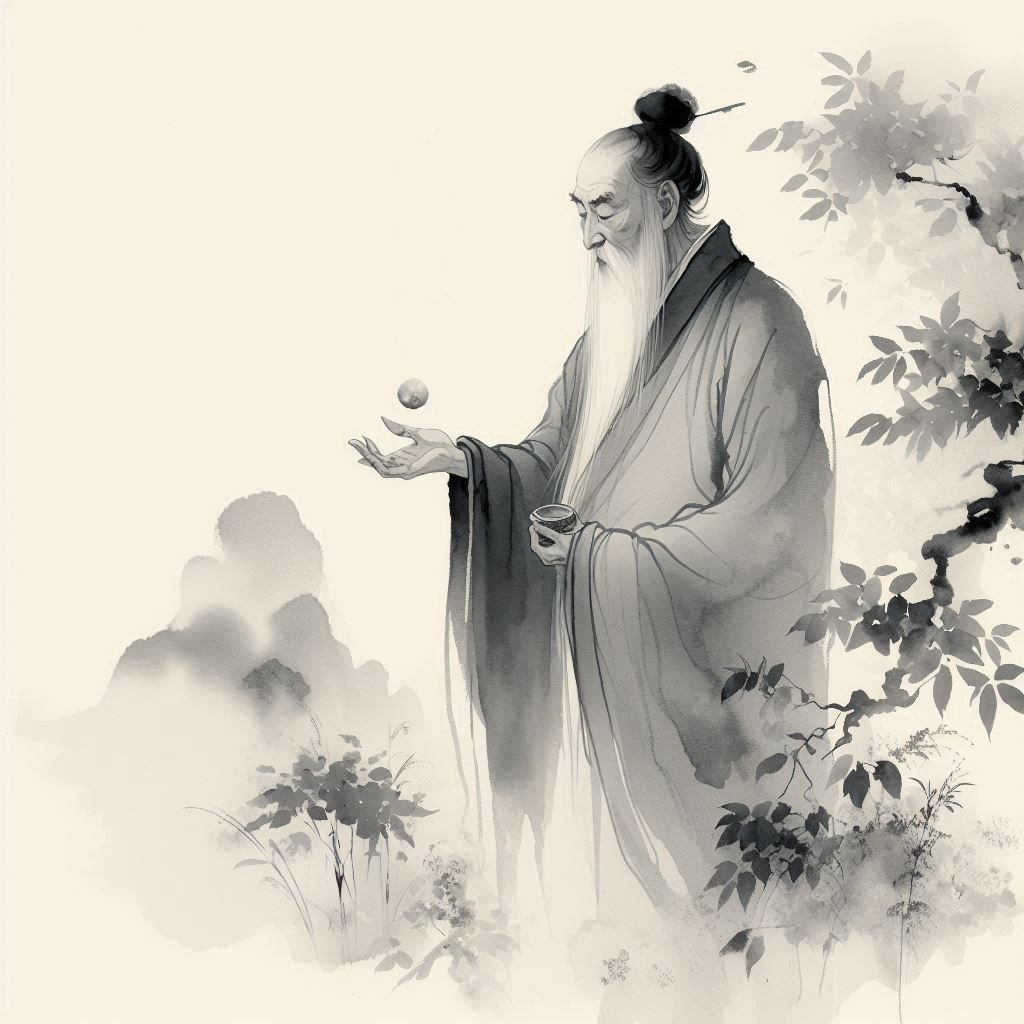
是以聖人被褐懷玉
📃 Meaning of the Original Text
My words are very easy to know, and very easy to practice.
Yet no one in the world can know them, and no one can practice them.
Words have an ancestral source; deeds have a sovereign principle.
It is precisely because they are not known that I am not known.
Those who know me are rare; therefore, I am precious.
This is why the sage wears coarse cloth on the outside, but carries jade within.
🌲 Line-by-Line Translation
吾言甚易知 甚易行 (wú yán shèn yì zhī, shèn yì xíng)
My words are very easy to know, and very easy to practice.
天下莫能知 莫能行 (tiān xià mò néng zhī, mò néng xíng)
Yet no one in the world can know them, and no one can practice them.
言有宗 事有君 (yán yǒu zōng, shì yǒu jūn)
Words have an ancestral source; deeds have a sovereign principle.
夫唯無知 是以不我知 (fū wéi wú zhī, shì yǐ bù wǒ zhī)
It is precisely because they are not known that I am not known.
知我者希 則我者貴 (zhī wǒ zhě xī, zé wǒ zhě guì)
Those who know me are rare; therefore, I am precious.
是以聖人被褐懷玉 (shì yǐ shèng rén bèi hè huái yù)
This is why the sage wears coarse cloth on the outside, but carries jade within.
💧 Verse-by-Verse Commentary and Interpretation (逐句解說與解釋)
1. 吾言甚易知 甚易行 (wú yán shèn yì zhī, shèn yì xíng)
o Literal Meaning: My words are very easy to know, and very easy to practice.
o Commentary: '吾言' (wú yán) means 'my words,' referring to the teachings of the Tao Te Ching, the principles of the Tao. '甚易知' (shèn yì zhī) means 'very (甚) easy (易) to know (知).' '甚易行' (shèn yì xíng) means 'very (甚) easy (易) to practice (行).' This asserts that the principles of the Tao are not complex or difficult, but are inherently simple and natural, making them easy for anyone to understand and practice.
o Interpretation: The teachings of the Tao are fundamentally simple and clear because they align with human nature and the flow of the natural world. It emphasizes that they do not require complicated theories or techniques.
2. 天下莫能知 莫能行 (tiān xià mò néng zhī, mò néng xíng)
o Literal Meaning: Yet no one in the world can know them, and no one can practice them.
o Commentary: '天下' (tiān xià) refers to the people of the world. '莫能知' (mò néng zhī) means 'no one can know.' '莫能行' (mò néng xíng) means 'no one can practice.' In direct contrast to the previous line, it presents the paradox that although the teachings are easy, in reality, no one can understand or practice them.
o Interpretation: Despite the claimed ease of the Tao's teachings, it points out the reality that people in the world neither know nor practice them. This implies that humans are so entangled in artificial desires and knowledge that they ignore the simple truth of the Tao and choose a more complicated path.
3. 言有宗 事有君 (yán yǒu zōng, shì yǒu jūn)
o Literal Meaning: Words have an ancestral source; deeds have a sovereign principle.
o Commentary: '言有宗' (yán yǒu zōng) means 'words (言, the teachings of the Tao) have (有) an ancestral source (宗).' Here, '宗' (zōng) means foundation, origin, or root, indicating that the teachings of the Tao originate from the Tao itself as their source. '事有君' (shì yǒu jūn) means 'deeds/affairs (事, the phenomena of the world) have (有) a sovereign/master (君).' Here, '君' (jūn) is interpreted as the governing principle, the master, or the Tao. It means that all worldly affairs, though they may seem chaotic, are governed by the fundamental principle of the Tao.
o Interpretation: Although the teachings of the Tao appear simple, they originate from a deep root (宗), the Tao, which is the source of all things. Similarly, all phenomena in the world (事) are not random but are governed by a fundamental master principle (君), which is also the Tao. This suggests that there is a profound principle behind the teachings of the Tao and the events of the world.
4. 夫唯無知 是以不我知 (fū wéi wú zhī, shì yǐ bù wǒ zhī)
o Literal Meaning: It is precisely because they are not known that I am not known.
o Commentary: '夫唯' (fū wéi) is an emphatic phrase meaning 'precisely because.' '無知' (wú zhī) refers to the state of not knowing the aforementioned '宗' (zōng) and '君' (jūn) of the Tao—that is, not knowing its fundamental principles. '是以' (shì yǐ) means 'for this reason.' '不我知' (bù wǒ zhī) is a construction meaning 'do not (不) know (知) me (我).' The meaning is that because people do not know the principles of the Tao ('宗' and '君'), they do not know 'me' (Laozi/the Tao) who embodies those principles.
o Interpretation: The reason people do not understand the teachings of the Tao (my words) is that they are unaware of the fundamental principles of the Tao—the source (宗) of the teachings and the master (君) of worldly phenomena. Because they are entangled in superficial phenomena and artificial knowledge, they fail to see the profound foundation of the Tao, and thus cannot truly understand the teachings, no matter how easy they seem.
5. 知我者希 則我者貴 (zhī wǒ zhě xī, zé wǒ zhě guì)
o Literal Meaning: Those who know me are rare; therefore, I am precious.
o Commentary: '知我者希' (zhī wǒ zhě xī) means 'those who (者) know (知) me (我, Laozi/the Tao) are rare (希).' In '則我者貴' (zé wǒ zhě guì), '則' (zé) can indicate a causal relationship ('therefore') or mean 'to take as a standard/model.' '我者' (wǒ zhě) can mean 'I myself' or 'those who follow me.' '貴' (guì) means precious, valuable, or honored.
- Interpretation 1 (Causal): Because those who know me are rare, I (Laozi/the Tao) am considered precious. (The rarity of the Tao or the sage enhances their value).
- Interpretation 2 (Follower): Because those who know me are rare, those who take me (Laozi/the Tao) as their standard and follow me are precious beings. (Those who follow the Tao are themselves rare and valuable).
- Both interpretations are possible and can suggest both the preciousness of the Tao and its followers. The first interpretation, 'because I am rarely known, my value becomes precious,' flows more naturally from the previous line.
o Interpretation: Because very few people understand the fundamental principles of the Tao, the teachings of the Tao and the sage (I) who embodies them are considered very rare and therefore precious in the world. This is a paradox: while the world values what is easily obtained, true value lies in what is rare and deep.
6. 是以聖人被褐懷玉 (shì yǐ shèng rén bèi hè huái yù)
o Literal Meaning: This is why the sage wears coarse cloth on the outside, but carries jade within.
o Commentary: '是以' (shì yǐ) means 'for this reason,' indicating the sage's attitude based on the preceding lines. '聖人' (shèng rén) is the ideal person who has realized the Tao. In '被褐' (bèi hè), '被' (bèi) means to wear, and '褐' (hè) means coarse, brown cloth, symbolizing a simple and unadorned appearance. In '懷玉' (huái yù), '懷' (huái) means to carry or cherish in one's heart, and '玉' (yù) symbolizes jade, treasure, precious value, or untainted essence.
o Interpretation: Knowing that the teachings of the Tao and his own being are rare and precious, the sage does not adorn himself lavishly on the outside but adopts a simple appearance (wearing coarse cloth). However, within his heart, he carries the precious and unchanging truth (jade) that the world does not recognize. This shows the importance of inner, essential value over outward appearance and symbolizes the humble and hidden nature of a follower of the Tao.
🌳 Overall Interpretation
Chapter seventy begins with Laozi speaking about his own teachings.
"My words (the teachings of the Tao) are in fact 'very easy to know, and very easy to practice.'" But strangely, "no one in the world 'truly knows them, nor truly practices them'." Why is it that something so easy is known or practiced by no one?
Laozi explains the reason: "My words did not just appear from nowhere; they 'have an ancestral source (宗),' and all the phenomena of the world do not happen by chance but are governed by a 'sovereign principle (君)'." This means that behind the teachings of the Tao and all worldly affairs lies a profound, fundamental principle.
"But people do not know this 'ancestral source and sovereign principle' of the Tao." "That is why, no matter how simple my words are, they cannot truly 'know me' (Laozi/the Tao) who embodies that essence." People only see what is on the surface and therefore cannot know the depth of the Tao.
"Thus, those who truly 'know me are very rare'." "For this reason, I (my teachings/the Tao) am 'considered precious' in the world." (Or: "those who model themselves after me are precious.") It has greater value because it cannot be easily obtained.
Because they understand this principle of the Tao—its depth within apparent simplicity and the rarity of its value—the sage who has realized the Tao does not adorn their appearance lavishly. They 'wear coarse cloth,' but within their heart, they 'carry a precious and unchanging truth (jade)' that the world does not recognize. They demonstrate through their own being that essence is more important than outward appearance.
🌟 The Meaning and Importance of Chapter 70
Chapter 70 presents the following core ideas:
- The Paradoxical Nature of the Tao: It presents the paradox that the teachings of the Tao are inherently 'easy,' yet the people of the world can 'neither know nor practice them,' showing the gap between the Tao's superficial simplicity and the difficulty of its actual understanding and practice.
- The Source and Sovereign of the Tao: It reveals that the Tao's teachings (言) have an ancestral source (宗) and that all worldly affairs (事) are governed by a sovereign principle (君), suggesting the profound and orderly nature behind the Tao.
- Human Ignorance and the Value of the Tao: It states that because people are ignorant of the Tao's source and sovereign principle, they cannot know the Tao. This very 'unknowability' makes the teachings of the Tao and the sage who embodies them 'rare and precious' in the world.
- The Attitude of the Sage (被褐懷玉): The symbolic phrase "wearing coarse cloth but carrying jade within" shows that the sage, knowing the value of the Tao, has a simple exterior (被褐) but possesses true value within (玉). This emphasizes the importance of the inner over the outer.
- The Limits of Knowledge: It suggests that worldly knowledge or observation of phenomena alone cannot grasp the essence of the Tao (宗, 君), and that true knowing lies in understanding the source.
Chapter 70 is an important chapter that simultaneously contains the philosophical depth and social critique of the Tao Te Ching. It points out the discrepancy between the Tao's inherent simplicity and humanity's artificial way of life, and paradoxically presents the profound nature of the Tao and the value of one who knows it. It carries the important message of directing a Taoist life toward cultivating the inner self and pursuing true value rather than outward appearances.


댓글