
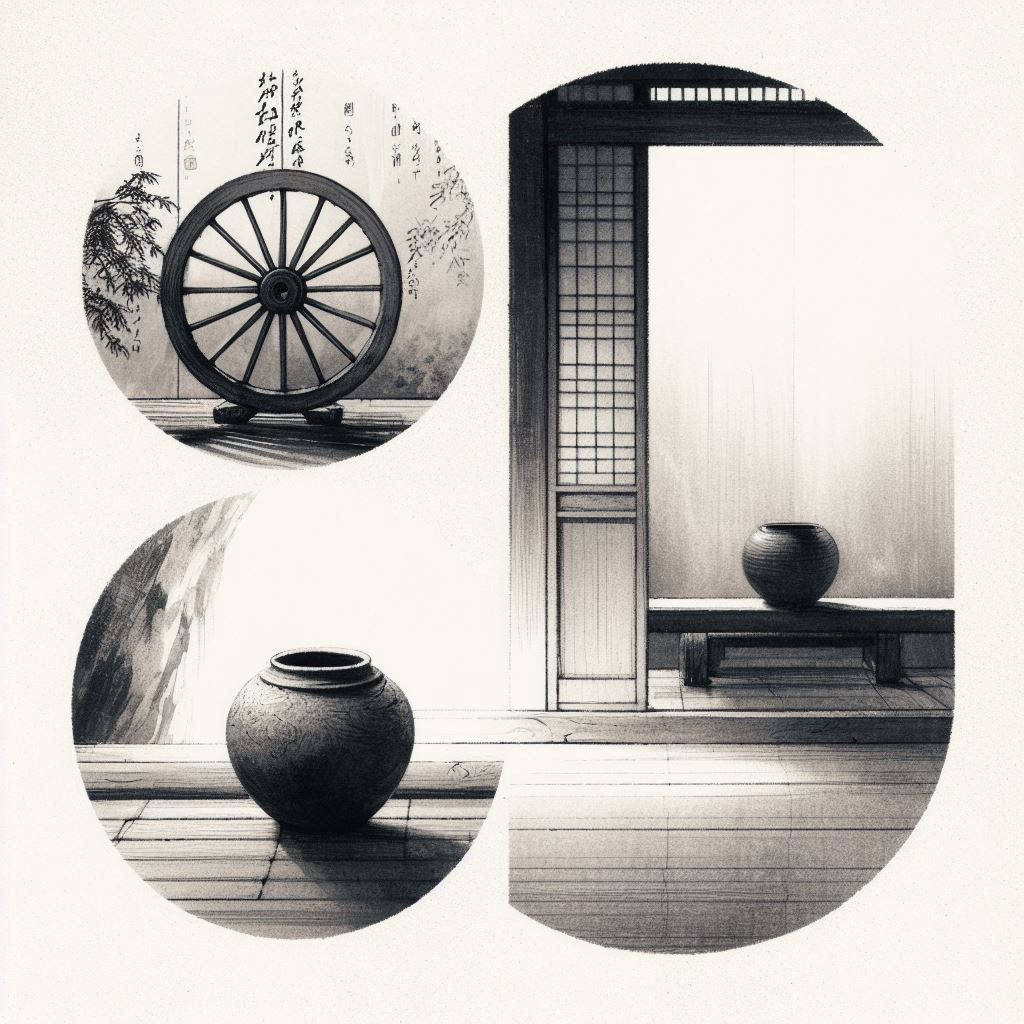
Chapter 11 of Laozi's Tao Te Ching presents the paradoxical truth that the utility of an object comes not from 'what is' (有), its physical substance, but rather from 'what is not' (無), its empty space. Through three concrete analogies, it emphasizes the value and importance of 'nothingness' (無), a core concept in Taoist thought that connects to the 'emptiness' (虛) of the Tao, the source of all things.
📜 Original Text (原文)
三十輻共一轂 當其無有車之用
埏埴以為器 當其無有器之用
鑿戶牖以為室 當其無有室之用
故有之以為利 無之以為用
📃 Meaning of the Original Text
Thirty spokes share one hub, but it is the empty space in the hub that gives the cart its use.
Clay is molded into a vessel, but it is the empty space within that gives the vessel its use.
Doors and windows are cut for a room, but it is the empty space within that gives the room its use.
Therefore, 'what is' (Being) provides advantage, but 'what is not' (Non-Being) creates usefulness.
🌲 Line-by-Line Translation
三十輻共一轂 當其無有車之用 (sān shí fú gòng yī gǔ, dāng qí wú, yǒu chē zhī yòng)
Thirty spokes share one hub, but it is the empty space in the hub that gives the cart its use.
埏埴以為器 當其無有器之用 (shān zhí yǐ wéi qì, dāng qí wú, yǒu qì zhī yòng)
Clay is molded into a vessel, but it is the empty space within that gives the vessel its use.
鑿戶牖以為室 當其無有室之用 (záo hù yǒu yǐ wéi shì, dāng qí wú, yǒu shì zhī yòng)
Doors and windows are cut for a room, but it is the empty space within that gives the room its use.
故有之以為利 無之以為用 (gù yǒu zhī yǐ wéi lì, wú zhī yǐ wéi yòng)
Therefore, 'what is' (Being) provides advantage, but 'what is not' (Non-Being) creates usefulness.
💧 Verse-by-Verse Commentary and Interpretation (逐句解說與解釋)
1. 三十輻共一轂 當其無有車之用 (sān shí fú gòng yī gǔ, dāng qí wú, yǒu chē zhī yòng)
o Literal Meaning: Thirty spokes share one hub, but it is on its nothingness that the cart's use depends.
o Commentary: '三十輻' (sān shí fú) means thirty spokes of a wheel. '共一轂' (gòng yī gǔ) means 'share one hub.' This describes the physical structure where spokes meet at the central hub. In '當其無' (dāng qí wú), '當' (dāng) means 'at that very point' or 'therein lies.' '其' (qí) refers to the hub, or more specifically, the empty space *within* the hub. '無' (wú) means 'nothingness' or 'emptiness.' '有車之用' (yǒu chē zhī yòng) means 'there is the use of the cart.'
o Interpretation: A wheel is made of thirty spokes and a hub. While these physical parts ('what is') form the wheel's structure, the wheel's ability to function as part of a cart depends on the empty hole in the center of the hub ('what is not'). An axle must be fitted into this hole for the wheel to turn and the cart to move. This shows that the physically 'non-existent' part is what enables the 'usefulness of the wheel.'
2. 埏埴以為器 當其無有器之用 (shān zhí yǐ wéi qì, dāng qí wú, yǒu qì zhī yòng)
o Literal Meaning: Clay is molded to make a vessel, but it is on its nothingness that the vessel's use depends.
o Commentary: '埏埴' (shān zhí) means 'to knead clay.' '以為器' (yǐ wéi qì) means 'to make a vessel.' In '當其無' (dāng qí wú), '其' (qí) refers to the vessel, or more specifically, the empty space *inside* it. '無' (wú) is the empty space within the vessel. '有器之用' (yǒu qì zhī yòng) means 'there is the use of the vessel.'
o Interpretation: The form of a vessel is created using clay ('what is'). While the clay provides its physical shape, the vessel's actual function of holding water or food depends on the empty space inside it ('what is not'). This analogy shows that the true usefulness of the vessel comes not from its 'being' (the clay) but from its 'non-being' (the emptiness).
3. 鑿戶牖以為室 當其無有室之用 (záo hù yǒu yǐ wéi shì, dāng qí wú, yǒu shì zhī yòng)
o Literal Meaning: Doors and windows are cut to make a room, but it is on its nothingness that the room's use depends.
o Commentary: '鑿戶牖' (záo hù yǒu) means 'to cut out doors (戶) and windows (牖).' '以為室' (yǐ wéi shì) means 'to make a room (室).' A room is a space enclosed by walls and a roof. In '當其無' (dāng qí wú), '其' (qí) refers to the room, or more specifically, the empty space *inside* it. '無' (wú) is the empty space. '有室之用' (yǒu shì zhī yòng) means 'there is the use of the room.'
o Interpretation: The shape of a room is created by walls, doors, and windows ('what is,' the physical structure). While these structures define the room's boundaries, the room's function as a space for people to live, work, and place things in depends on the empty space within it ('what is not'). This analogy shows that a building's utility relies not just on its 'being' (walls, roof) but on its 'non-being' (the empty space inside).
4. 故有之以為利 無之以為用 (gù yǒu zhī yǐ wéi lì, wú zhī yǐ wéi yòng)
o Literal Meaning: Therefore, 'what is' provides advantage, but 'what is not' creates usefulness.
o Commentary: '故' (gù) is a conjunction meaning 'therefore,' drawing a conclusion from the three preceding analogies. In '有之以為利' (yǒu zhī yǐ wéi lì), '有之' (yǒu zhī) refers to 'what is' (Being). '以為利' (yǐ wéi lì) means 'creates advantage/benefit' (利). The physical structure, materials, etc.—'what is'—provide a form and a certain benefit. In '無之以為用' (wú zhī yǐ wéi yòng), '無之' (wú zhī) refers to 'what is not' (Non-Being), the empty space. '以為用' (yǐ wéi yòng) means 'creates usefulness/function' (用). The empty space provides the actual function or utility.
o Interpretation: This line generalizes the lesson from the three analogies. The physical form or material of an object—'what is'—provides the 'advantage' (利) of having a structure and foundation. However, the object's ability to fulfill its intended role and function is thanks to its empty part—'what is not' (無). It emphasizes the paradoxical truth that while form is created by 'Being,' the usefulness of that form is created by 'Non-Being.'
🌳 Overall Interpretation
The eleventh chapter speaks of the profound value that lies beyond what is visible.
Consider a wheel: thirty spokes converge at a central hub. Yet, what allows the wheel to turn and serve its purpose is not the solid part of the hub, but the 'empty hole' in its center. The wheel moves only when an axle is placed in that hole.
Think about making a pot from clay. The shape of the pot is made of clay, but its ability to hold water or food comes from the 'empty space' inside.
Similarly, when we build a room by putting up walls and cutting doors and windows, the walls and roof create the physical form, but what makes it a space where people can live and place things is the 'empty space' inside the room.
So, we must realize this: 'what is' (有) provides the 'advantage' of a form and a basic foundation, but its actual function and 'usefulness' (用) come from 'what is not' (無)—the 'empty space' within it.
🌟 The Meaning and Importance of Chapter 11
Chapter 11 presents the following core ideas:
- The Functional Value of Nothingness (無): It paradoxically emphasizes that 'what is not' (無)—empty space, which is often overlooked in favor of physical existence ('what is')—is the key element that determines an object's actual function and utility.
- The Interdependence of Being (有) and Non-Being (無): An object's form is created by 'Being,' but its usefulness is made possible by 'Non-Being.' 'Being' and 'Non-Being' are not just opposing concepts but are complementary and mutually dependent, working together to complete the function of all things.
- Connection to the Emptiness (虛) of the Tao (道): The Tao, the source of all things, also possesses the quality of being formless and empty—'nothingness' (無) or 'emptiness' (虛). Chapter 11 indirectly explains how this emptiness of the Tao enables the infinite potential and function of all things through these concrete analogies.
- A Lesson for Life: It suggests that instead of clinging only to material possessions or visible things ('what is'), we should recognize and value 'what is not'—such as emptiness, breathing room, and mental space. More possibilities arise not from constantly filling but from knowing when to empty.
Chapter 11 is a crucial chapter that shows the Taoist concept of 'nothingness' (無) does not simply mean 'absence,' but rather signifies the fundamental state from which all potential and function originate. It persuasively presents profound philosophy through everyday analogies, prompting deep reflection on the power and value of the empty space that lies beyond the visible, material world.


댓글