
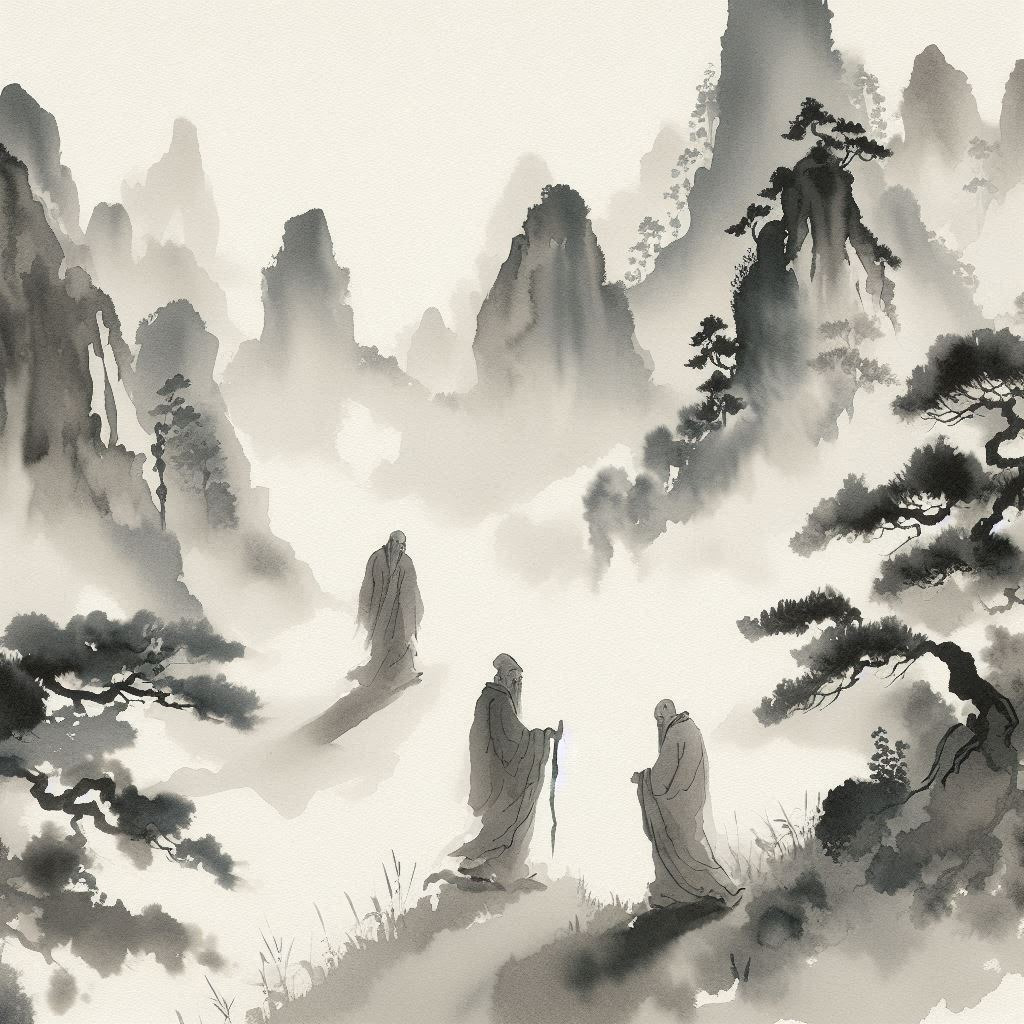
Chapter 15 of Laozi's Tao Te Ching describes the appearance and characteristics of the ideal figures of antiquity ('善為士者', masters or sages) who skillfully cultivated and embodied the Tao (道). Through analogies, it explains their deep and unfathomable inner nature and their various humble, cautious, and natural attitudes revealed externally, thereby showing a concrete picture of a life that follows the Tao.
📖 Table of Contents
- ✨ Introduction
- 📜 Original Text (原文)
- 📃 Meaning of the Original Text
- 🌲 Line-by-Line Translation
- 💧 Verse-by-Verse Commentary and Interpretation
- 古之善爲士者 微妙玄通 深不可識 (gǔ zhī shàn wéi shì zhě, wēi miào xuán tōng, shēn bù kě shí)
- 夫唯不可識 故強爲之容 (fū wéi bù kě shí, gù qiǎng wéi zhī róng)
- 豫兮若冬涉川 猶兮若畏四隣 儼兮其若客 渙兮其若冰之將釋 敦兮其若樸 曠兮其若谷 混兮其若濁 (yù xī ruò dōng shè chuān, yóu xī ruò wèi sì lín, yǎn xī qí ruò kè, huàn xī qí ruò bīng zhī jiāng shì, dūn xī qí ruò pǔ, kuàng xī qí ruò gǔ, hùn xī qí ruò zhuó)
- 孰能濁以靜之徐清 (shú néng zhuó yǐ jìng zhī xú qīng)
- 孰能安以動之徐生 (shú néng ān yǐ dòng zhī xú shēng)
- 保此道者不欲盈 (bǎo cǐ dào zhě bù yù yíng)
- 夫唯不欲盈 故能蔽而新成 (fū wéi bù yù yíng, gù néng bì ér xīn chéng)
- 🌳 Overall Interpretation
- 🌟 The Meaning and Importance of Chapter 15
📜 Original Text (原文)
古之善爲士者 微妙玄通 深不可識
夫唯不可識 故強爲之容
豫兮若冬涉川 猶兮若畏四隣 儼兮其若客 渙兮其若冰之將釋 敦兮其若樸 曠兮其若谷 混兮其若濁
孰能濁以靜之徐清
孰能安以動之徐生
保此道者不欲盈
夫唯不欲盈 故能蔽而新成
(Note: Depending on the version of the Tao Te Ching, the order or characters of some phrases may differ. The original text above follows one of the commonly accepted versions.)
📃 Meaning of the Original Text
The ancient masters of the Tao were subtle, mysterious, profound, and penetrating; their depth could not be fathomed.
Because they could not be fathomed, one can only try to describe their appearance.
They were cautious, like one crossing a river in winter.
They were hesitant, like one who fears their neighbors on all sides.
They were reserved, like a guest.
They were yielding, like ice about to melt.
They were simple, like an uncarved block of wood.
They were open, like an empty valley.
They were murky, like muddy water.
Who can, in turbidity, become still and gradually clear?
Who can, in stillness, be moved and gradually brought to life?
One who holds this Tao does not wish to be full.
Because they do not wish to be full, they can be worn and yet be constantly renewed.
🌲 Line-by-Line Translation
古之善爲士者 微妙玄通 深不可識 (gǔ zhī shàn wéi shì zhě, wēi miào xuán tōng, shēn bù kě shí)
The ancient masters of the Tao were subtle, mysterious, profound, and penetrating; their depth could not be fathomed.
夫唯不可識 故強爲之容 (fū wéi bù kě shí, gù qiǎng wéi zhī róng)
Because they could not be fathomed, one can only try to describe their appearance.
豫兮若冬涉川 猶兮若畏四隣 儼兮其若客 渙兮其若冰之將釋 敦兮其若樸 曠兮其若谷 混兮其若濁 (yù xī ruò dōng shè chuān, yóu xī ruò wèi sì lín, yǎn xī qí ruò kè, huàn xī qí ruò bīng zhī jiāng shì, dūn xī qí ruò pǔ, kuàng xī qí ruò gǔ, hùn xī qí ruò zhuó)
Cautious, like one crossing a river in winter. Hesitant, like one who fears their neighbors on all sides. Reserved, like a guest. Yielding, like ice about to melt. Simple, like an uncarved block of wood. Open, like an empty valley. Murky, like muddy water.
孰能濁以靜之徐清 (shú néng zhuó yǐ jìng zhī xú qīng)
Who can, in turbidity, become still and gradually clear?
孰能安以動之徐生 (shú néng ān yǐ dòng zhī xú shēng)
Who can, in stillness, be moved and gradually brought to life?
保此道者不欲盈 (bǎo cǐ dào zhě bù yù yíng)
One who holds this Tao does not wish to be full.
夫唯不欲盈 故能蔽而新成 (fū wéi bù yù yíng, gù néng bì ér xīn chéng)
Because they do not wish to be full, they can be worn and yet be constantly renewed.
💧 Verse-by-Verse Commentary and Interpretation (逐句解說與解釋)
1. 古之善爲士者 微妙玄通 深不可識 (gǔ zhī shàn wéi shì zhě, wēi miào xuán tōng, shēn bù kě shí)
o Literal Meaning: The masters of old who were skilled in the way were subtle, mysterious, profound, and penetrating; their depth was unknowable.
o Commentary: '古之善爲士者' (gǔ zhī shàn wéi shì zhě) means 'those of old who were good at being scholars/masters.' Here, '士' (shì) does not just mean a scholar or lower official, but rather a sage, adept, or ideal person who has reached a high state of being through practicing the Tao. '微妙玄通' (wēi miào xuán tōng) means 'subtle (微妙), profound (玄), and penetrating (通).' '深不可識' (shēn bù kě shí) means 'so deep (深) they cannot be known (不可識).'
o Interpretation: This line states that the ancient practitioners of the Tao had an inner nature so deep and subtle, and were so attuned to the truth of the Tao, that ordinary people could not fathom their profundity. Their depth could not be understood through their outward appearance or words alone.
2. 夫唯不可識 故強爲之容 (fū wéi bù kě shí, gù qiǎng wéi zhī róng)
o Literal Meaning: Because they are unknowable, I will venture to describe their appearance.
o Commentary: '夫唯' (fū wéi) is an emphatic phrase meaning 'precisely because.' '不可識' (bù kě shí) means 'cannot be known.' '故' (gù) means 'therefore.' In '強爲之容' (qiǎng wéi zhī róng), '強' (qiǎng) means to force or to make an effort. '爲之容' (wéi zhī róng) means 'to make (爲) an image/appearance (容) of it (之),' i.e., to describe it.
o Interpretation: Because their true nature and inner depth cannot be fathomed, Laozi states that he will try his best ('強爲') to describe their external attitudes and appearance ('容'). This implies that while the essence of a Taoist master is hard to grasp, we can understand them indirectly through the way they present themselves to the world.
3. 豫兮若冬涉川 猶兮若畏四隣 儼兮其若客 渙兮其若冰之將釋 敦兮其若樸 曠兮其若谷 混兮其若濁 (yù xī ruò dōng shè chuān, yóu xī ruò wèi sì lín, yǎn xī qí ruò kè, huàn xī qí ruò bīng zhī jiāng shì, dūn xī qí ruò pǔ, kuàng xī qí ruò gǔ, hùn xī qí ruò zhuó)
o Literal Meaning: Cautious, like one crossing a river in winter. Hesitant, like one who fears their neighbors on all sides. Reserved, like a guest. Yielding, like ice about to melt. Simple, like an uncarved block of wood. Open, like an empty valley. Murky, like muddy water.
o Commentary: This section uses seven analogies to describe the characteristics of the ancient masters. The particle '兮' (xī) is an exclamatory or tonal particle.
- 豫兮若冬涉川 (yù xī ruò dōng shè chuān): '豫' (yù) means hesitant, cautious. '若冬涉川' (ruò dōng shè chuān) means 'like crossing a river in winter.' This is an analogy for extreme caution, as one would be when testing thin ice. (Caution, Prudence)
- 猶兮若畏四隣 (yóu xī ruò wèi sì lín): '猶' (yóu) means hesitant, vigilant. '若畏四隣' (ruò wèi sì lín) means 'like one who fears neighbors on all four sides.' An analogy for being constantly aware and mindful of one's surroundings. (Vigilance, Alertness)
- 儼兮其若客 (yǎn xī qí ruò kè): '儼' (yǎn) means grave, respectful, reserved. '其若客' (qí ruò kè) means 'like a guest.' An analogy for behaving with courtesy, politeness, and a sense of detachment, as if one were a visitor in the world. (Reverence, Politeness, Detachment)
- 渙兮其若冰之將釋 (huàn xī qí ruò bīng zhī jiāng shì): '渙' (huàn) means to disperse, melt, be fluid. '其若冰之將釋' (qí ruò bīng zhī jiāng shì) means 'like ice that is about to melt.' An analogy for being flexible, adaptable, and not rigid or stubborn. (Flexibility, Adaptability, Unattachment)
- 敦兮其若樸 (dūn xī qí ruò pǔ): '敦' (dūn) means substantial, simple, honest. '其若樸' (qí ruò pǔ) means 'like an uncarved block of wood' (樸, pǔ). An analogy for possessing a pure, simple, and unadorned nature. (Purity, Simplicity, Authenticity)
- 曠兮其若谷 (kuàng xī qí ruò gǔ): '曠' (kuàng) means empty, vast, open-minded. '其若谷' (qí ruò gǔ) means 'like an empty valley' (谷, gǔ). An analogy for a mind that is open, receptive, and free from desire, able to contain all things. (Openness, Humility, Receptivity)
- 混兮其若濁 (hùn xī qí ruò zhuó): '混' (hùn) means mixed, chaotic. '其若濁' (qí ruò zhuó) means 'like muddy water' (濁, zhuó). An analogy for appearing indistinct, blending in with the world, and concealing one's brilliance, not standing out from ordinary people. (Concealing brilliance, Harmony with the world, Obscurity)
o Interpretation: These seven analogies reveal the multifaceted nature of those who follow the Tao. They are supremely cautious and vigilant, yet maintain a polite and humble attitude toward the world. They are also flexible and adaptable, simple and without artifice. Their minds are open and receptive, and they do not show off their brilliance, preferring to blend in with their surroundings.
4. 孰能濁以靜之徐清 (shú néng zhuó yǐ jìng zhī xú qīng)
o Literal Meaning: Who can, in turbidity, become still and gradually clear?
o Commentary: '孰能' (shú néng) is a rhetorical question: 'Who is able to...?' '濁以靜之徐清' (zhuó yǐ jìng zhī xú qīng) means 'to take what is turbid (濁) and, by making it still (以靜之), gradually (徐) make it clear (清).' The '之' (zhī) refers back to the '濁' (zhuó).
o Interpretation: This is a question about who has the ability to resolve a chaotic or complex situation (what is turbid) not by forceful, artificial intervention, but by quieting the mind and allowing things to settle naturally, leading to clarity and resolution. It points to the Taoist wisdom of achieving natural healing and order through non-action (無為, wú wéi) and empty stillness (虛靜, xū jìng).
5. 孰能安以動之徐生 (shú néng ān yǐ dòng zhī xú shēng)
o Literal Meaning: Who can, in stillness, be moved and gradually brought to life?
o Commentary: '孰能' (shú néng) is the same rhetorical question. In '安以動之徐生' (ān yǐ dòng zhī xú shēng), '安' (ān) refers to a state of stillness or stability. '以動之徐生' (yǐ dòng zhī xú shēng) means 'by moving it (以動之), to gradually (徐) bring it to life (生).' The '之' (zhī) refers back to the '安' (ān).
o Interpretation: This is a question about who can take a stagnant or still situation and, without resorting to abrupt, artificial creation, allow it to be moved by the natural workings of the Tao, gradually giving rise to vitality and life. It asks about the Taoist way of facilitating change and growth through natural momentum rather than forceful action. Together with the previous question, it highlights the adept's ability to guide change and creation in accordance with the principles of nature, not through artificial effort.
6. 保此道者不欲盈 (bǎo cǐ dào zhě bù yù yíng)
o Literal Meaning: One who holds this Tao does not wish to be full.
o Commentary: '保此道者' (bǎo cǐ dào zhě) means 'the person (者) who preserves (保) this Tao (此道).' '不欲盈' (bù yù yíng) means 'does not wish (不欲) to be full/complete (盈).' Here, '盈' (yíng) signifies more than physical fullness; it implies an arrogance or satisfaction in believing one's abilities, knowledge, or accomplishments are perfect and complete, or a stagnant state with no room for further change or growth.
o Interpretation: One who has embodied the Tao and upholds its principles in life does not become complacent, thinking, "This is enough," or "I am complete." They do not believe their state has no more room for growth. It describes an attitude of constant humility, acknowledging imperfection, and not being attached to perfection or a final goal.
7. 夫唯不欲盈 故能蔽而新成 (fū wéi bù yù yíng, gù néng bì ér xīn chéng)
o Literal Meaning: Because they do not wish to be full, they can be worn and yet be constantly renewed.
o Commentary: '夫唯不欲盈' (fū wéi bù yù yíng) emphasizes the previous phrase ('Precisely because they do not wish to be full'). '故' (gù) means 'therefore.' In '能蔽而新成' (néng bì ér xīn chéng), '能' (néng) means 'is able to.' '蔽' (bì) has meanings like to cover, to hide, to be simple, or to be worn out. '而' (ér) is a conjunction. '新成' (xīn chéng) means 'to be newly completed' or 'to be constantly renewed.'
o Interpretation: This is a paradox. Because the sage or follower of the Tao does not seek a state of fullness ('盈') regarding their knowledge or accomplishments, they maintain a state of humility and imperfection ('蔽,' appearing worn or simple). As a result, they are able to continuously evolve and be renewed. Instead of stopping at a perceived state of perfection, they embrace incompleteness, which allows for endless growth and opens up new possibilities. This reveals a profound Taoist wisdom.
🌳 Overall Interpretation
The fifteenth chapter describes the nature of those in ancient times who were true masters of the Tao.
Their inner being was so subtle and mysterious, deeply attuned to the truth of the Tao, that ordinary people simply could not fathom their depth. Because they were so unfathomable from the outside, I will try to describe their outward attitudes and appearances through analogies.
They were as cautious and prudent as someone crossing a frozen river in deep winter, and as vigilant as someone wary of enemies on all sides. They also showed a reserved and courteous attitude, like a guest visiting a foreign land. They were not rigid but flexible and adaptable to change, like ice about to melt. They possessed a pure and simple nature, like an uncarved block of wood, and were as open and receptive as an empty valley, able to accept all things. And they appeared indistinct and blended in with the world, like muddy water (meaning they did not deliberately show off their brilliance).
Who is the one that can take a chaotic and complex situation (the turbid) and, without resorting to artificial solutions, allow it to settle naturally into clarity by remaining still and patient? Who is the one that can take a stagnant and quiet state and, without imposing abrupt, artificial change, allow vitality and life to emerge gradually according to the natural flow of the Tao? These are the people who know the Tao.
The person who follows this Tao and preserves it in their life does not desire to be full—they do not think, "This is enough," or "I am complete," regarding their knowledge, abilities, or achievements. Precisely because they do not seek to fill themselves up, they always acknowledge their own incompleteness and maintain a simple and humble state. As a result, they are able to continuously evolve and be newly perfected.
🌟 The Meaning and Importance of Chapter 15
Chapter 15 presents the following core ideas:
- The Ideal Taoist Master: Chapter 15 describes the inner depth and outward demeanor of the ideal human figure who has embodied the Tao ('善為士者'). They are unfathomably profound, and outwardly they display various virtues such as caution, vigilance, humility, flexibility, simplicity, openness, and the concealment of their brilliance.
- Guiding Natural Change and Creation: The Taoist master resolves chaos through stillness (濁以靜之徐清) and brings forth life from a state of rest (安以動之徐生), all without artificial effort. This demonstrates that they have mastered the Tao's principle of natural functioning.
- The Wisdom of Not Desiring Fullness (不欲盈): It emphasizes the importance of the attitude of 'not desiring to be full'—not being satisfied or seeking perfection in one's knowledge, abilities, or achievements.
- Humility and Continuous Development: Because they have this attitude of 'not desiring fullness,' the master always acknowledges their shortcomings and maintains a simple state (蔽). The chapter presents the paradoxical truth that, as a result, they are able to be constantly renewed and newly perfected (新成).
Chapter 15 is an important chapter that projects the abstract concept of the Tao onto a concrete human ideal. It explains, through vivid analogies, how following the Tao is not merely a theoretical understanding but is manifested in one's attitude and way of life. It presents the possibility of a harmonious life and continuous growth, which are attained by abandoning attachment to perfection and embracing humility, caution, and flexibility.


댓글