
🔗 De Jing (德經): The Manifestation of the Tao (道) as Virtue (德) and Its Practice
The Tao Jing primarily explains the metaphysical characteristics and functions of the 'Tao (道)' itself—the origin of the universe and the law of nature.
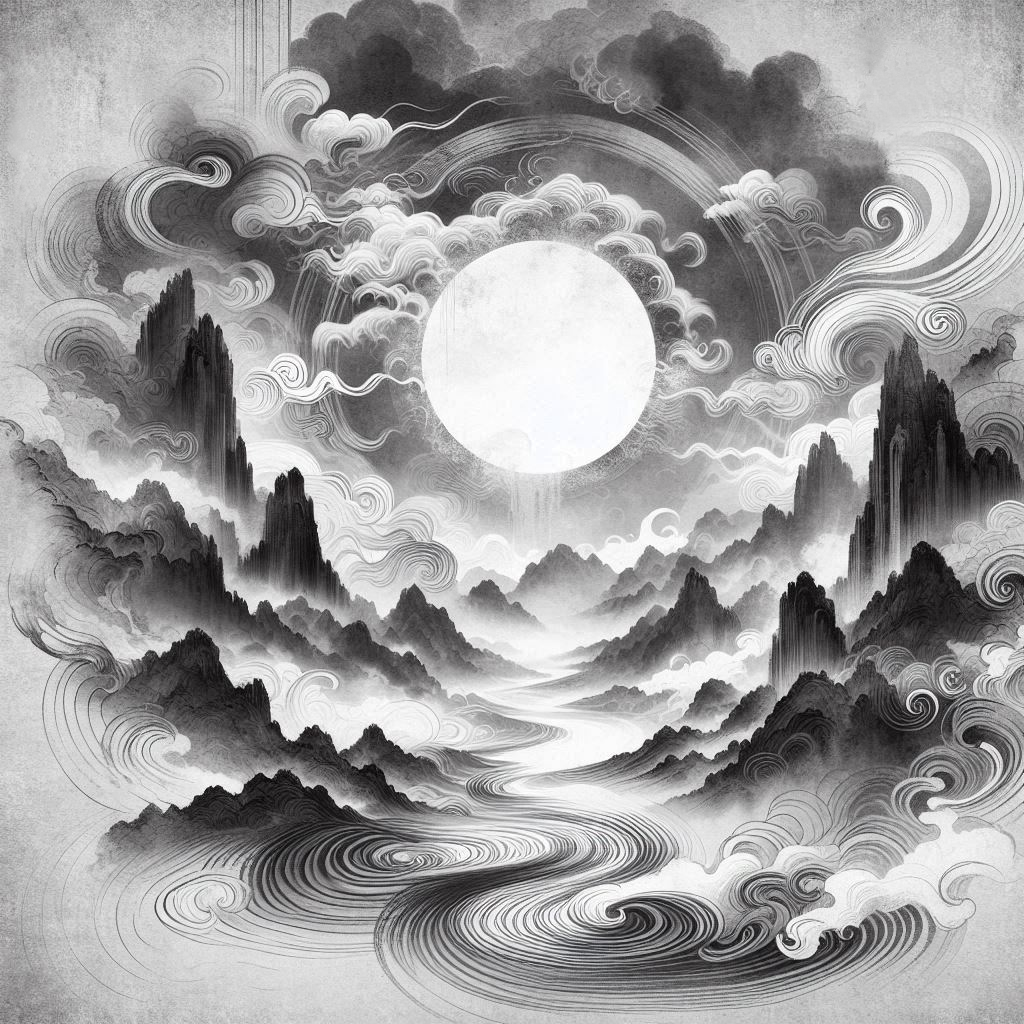
Chapter 1: The Tao Cannot Be Named
It states that the Tao, the origin of all things, is an absolute reality that cannot be captured or explained by language or concepts. The named is the mother of all things, while the nameless is the beginning of Heaven and Earth.
Chapter 2: The Principle of the Interdependence of Being and Non-Being (有無相生)
It explains that opposites such as being and non-being, difficult and easy, long and short, depend on each other for their existence. It also states that the sage acts without deliberate effort and teaches without words.
Chapter 3: The Basics of Governing Through Non-Action (無為之治)
It says that the sage governs by emptying the people's minds and filling their bellies, weakening their ambitions and strengthening their bones, and keeping them without knowledge or desire. The importance of leading people naturally, without force, is key.
Chapter 4: The Tao is Empty but Inexhaustible
The Tao is described as an empty vessel, a fundamental reality that is never used up, no matter how much it is drawn from. It is the ancestor of all things, and its depth is unfathomable.
Chapter 5: Heaven and Earth are Impartial (不仁)
It explains metaphorically that Heaven and Earth are not benevolent or malevolent to any specific being but treat all things impartially. Likewise, the sage does not manipulate the people but allows them to be natural.
Chapter 6: The Spirit of the Valley Never Dies (谷神不死)
Using the analogy of the 'Valley Spirit' (谷神, gǔ shén), which is empty yet gives birth and nurtures life, it states that the fundamental power of the Tao acts ceaselessly, like the life-giving force of the feminine.
Chapter 7: The Eternity of Heaven and Earth
It says that Heaven and Earth are eternal because they do not live for themselves. Similarly, the sage, by not putting himself forward, finds his existence preserved and made eternal.
Chapter 8: The Highest Good is Like Water (上善若水)
Stating that the highest good is like water, it praises the virtues of humility and flexibility, as water benefits all things without contention and dwells in low places that everyone dislikes.
Chapter 9: Moderation and Contentment (知足)
It states that what is filled to the brim or sharpened to a fine point cannot last long. It emphasizes the importance of humility in withdrawing after achieving success and the wisdom of knowing contentment (知足, zhī zú) when one is rich in possessions.
Chapter 10: The Practice of Non-Action and Virtue
It presents ways to live naturally through the posture of non-action (無為, wú wéi): embracing the soul and body as one, cultivating virtue, emptying the mind, and governing with peace.
Chapter 11: The Usefulness of Nothingness (無)
It explains that the empty space between the spokes of a wheel, the void inside a vessel, and the empty interior of a room determine their usefulness. It emphasizes the value of emptiness.
Chapter 12: Warning Against Sensory Indulgence
It warns that indulging in the five senses and desires—dazzling colors, loud sounds, exquisite tastes, rare objects—blinds the eyes, deafens the ears, and deranges the mind.
Chapter 13: The Source of Honor and Disgrace
It states that both honor (榮, róng) and disgrace (辱, rǔ) arise from the self, and that anxiety exists because we have a body (身, shēn). It values caring for the world more than cherishing one's own body.
Chapter 14: The Formlessness of the Tao
It emphasizes the formlessness of the Tao—unseen when looked for, unheard when listened for, and ungrasped when touched. It states that this unnamable, chaotic state is the origin of all things.
Chapter 15: The Appearance of the Ancient Masters
It describes the deep, subtle, and mysterious appearance of the ancient masters of the Tao, suggesting we should emulate their caution, vigilance, humility, and simplicity.
Chapter 16: Emptiness, Stillness, and Returning to the Root
It advises attaining enlightenment by achieving ultimate emptiness (虛, xū) and maintaining deep stillness (靜, jìng), observing the natural principle that all things arise, change, and then return to their root (復命, fù mìng). This is to know the eternal.
Chapter 17: The Ideal Ruler
The best ruler is one whose existence the people are barely aware of. The next best is one who is loved and praised. The next is one who is feared, and the worst is one who is despised. The ideal rule is when, upon success, the people say, "We did it ourselves."
Chapter 18: When the Tao and De Decline
When the great Tao is abandoned, benevolence and righteousness (仁義, rén yì) arise. When wisdom and sagacity appear, great hypocrisy emerges. When family relations are not harmonious, filial piety and love are declared. When the country is in chaos, loyal ministers appear. This paradox suggests that when these virtues are emphasized as artificial concepts, it is a sign of decline, as they were practiced naturally when the Tao was whole.
Chapter 19: Simplicity and Reducing Desire
It states that if you abandon sagehood and wisdom, benevolence and righteousness, and skill and profit, the people will benefit. Fundamentally, it emphasizes maintaining simplicity and reducing desire.
Chapter 20: Difference from the World
Unlike worldly people who are excited, cheerful, and busy, the speaker claims to be alone, calm, and detached, like a newborn child not bound by worldly conventions, showing the lonely path of a follower of the Tao.
Chapter 21: The Functioning of the Tao
It describes the formlessness and elusiveness of the Tao, within which all things arise and substance exists. It states that from ancient times to the present, the Tao has operated without change.
Chapter 22: The Victory of Humility and Flexibility
Through paradoxes—"yield and overcome," "bend and be straight," "empty and be full," "be worn and be new"—it states that one who is humble, flexible, and does not assert oneself will instead achieve wholeness and victory.
Chapter 23: Naturalness and Unity with the Tao
Just as a fierce wind or a sudden storm does not last long, what is artificial cannot endure. It states that one who follows the Tao becomes one with the Tao, and one who follows virtue becomes one with virtue.
Chapter 24: The Limits of Artificial Effort
It points out the futility of artificial effort and showing off: one who stands on tiptoe cannot stand firm; one who takes long strides cannot go far; one who displays himself does not shine; one who asserts his own views is not recognized.
Chapter 25: The Greatness of the Tao and the Four Great Things
It describes the great, unchanging Tao that existed before all things and states that there are four great things in the universe (the Tao, Heaven, Earth, and the King), and that the king, as one of them, must model himself on the Tao.
Chapter 26: The Importance of Heaviness
It states that the heavy is the root of the light, and the still is the master of the restless. It emphasizes that the sage must always maintain a heavy and calm demeanor.
Chapter 27: A Life Without Traces
Through analogies—a good traveler leaves no tracks, a good speaker makes no slips, a good door needs no bolts yet cannot be opened—it speaks to the importance of 'goodness' that acts naturally without leaving artificial traces or interventions.
Chapter 28: Know the Masculine, Keep to the Feminine (知其雄 守其雌)
By knowing strength (the masculine) but keeping to gentleness (the feminine), knowing brightness but keeping to darkness, and knowing honor but keeping to disgrace, one returns to the simple, uncarved nature (朴, pǔ) and achieves natural virtue.
Chapter 29: Opposition to Artificial Rule
It states that one who tries to conquer the world with artificial force will not succeed, warning that the world is a sacred vessel that is ruined if tampered with or grasped.
Chapter 30: The Evils of War
It states that a follower of the Tao does not seek to dominate the world with military force, criticizing the tragic and harmful consequences of war, as armies lay waste to the land and bring famine.
Chapter 31: Weapons are Inauspicious Tools
It states that weapons are inauspicious tools disliked by followers of the Tao, emphasizing an attitude that seeks peace and quietude and does not celebrate victory in war as a joyous occasion.
Chapter 32: The Eternity and Simplicity of the Tao
The Tao is eternal and nameless, but when it is divided and names arise, one must know when to stop to avoid danger. It emphasizes the value of the Tao's fundamental simplicity (朴, pǔ).
Chapter 33: Knowing Others is Wisdom; Knowing Oneself is Enlightenment
It states that knowing others is wisdom (知人者智, zhī rén zhě zhì), but knowing oneself is true enlightenment (自知者明, zì zhī zhě míng). Conquering others requires force, but conquering oneself is true strength, emphasizing the importance of self-cultivation.
Chapter 34: The Tao is Everywhere
The great Tao flows everywhere, reaching all places. It nurtures all things without claiming ownership and achieves great works without seeking a name for itself, describing the humble and beneficial action of the Tao.
Chapter 35: Following the Tao Brings Peace
If you hold to the Great Image (the Tao), the whole world will come to you in peace, without harm. Music and food may make a traveler stop, but the taste of the Tao is bland and its form is unremarkable, yet its function is inexhaustible.
Chapter 36: The Victory of the Soft and Weak
Through paradoxes—to shrink something, you must first expand it; to weaken something, you must first strengthen it; to discard something, you must first raise it up—it explains the principle that the soft and weak overcome the hard and strong.
Chapter 37: The Tao is Non-Action, Yet Nothing is Left Undone
The Tao does nothing (無為, wú wéi), yet through it, nothing is left undone. If rulers could hold to it, all things would transform themselves. If desires arise, they can be subdued by the 'Nameless Simplicity' (無名之朴, wú míng zhī pǔ) to achieve peace.

🔗 De Jing (德經): The Manifestation of the Tao (道) as Virtue (德) and Its Practice (Chapters 38 ~ 81)
'명상: 마음의 평화를 위한 지혜 > Laozi's Tao Te Ching' 카테고리의 다른 글
| Laozi's Tao Te Ching Chapter 3: Governing Through Simplicity (0) | 2025.09.08 |
|---|---|
| Laozi's Tao Te Ching Chapter 2: Relative Concepts and the Sage's Wu Wei (0) | 2025.09.07 |
| Laozi's Tao Te Ching Chapter 1: The Tao (道) Cannot Be Named (0) | 2025.09.07 |
| De Jing (德經): The Manifestation of the Tao (道) as Virtue (德) and Its Practice (0) | 2025.09.07 |
| About Laozi's Tao Te Ching (老子 道德經) (0) | 2025.09.06 |


댓글